The city print is plus 1.55% on the quarter. Compounded quarterly that is plus 74% by 2035, annually it is plus 15%. Plan around what is contracted instead.
Written by Mansi Joshi, Marketing Intelligence Lead, ZYN33 Investment Desk. Reviewed by Ritesh Arora, Founder, ZYN33 and Strata Capital Holdings, Gurugram. Advising on Gurugram residential capital allocation since 2023, with mandates ranging from Rs 3 Cr to Rs 50 Cr. Published 26 November 2025. Last reviewed 2 October 2026.
Disclosure: ZYN33 distributes residential projects in Gurugram and is paid a transaction fee when a purchase completes, including on projects we discuss with you. We do not give tax advice. This post is general information. Take it to your chartered accountant.
Nobody can forecast 2035, and the arithmetic shows why. Gurugram's city print is plus 1.55% on the quarter. Read that as quarterly and you get plus 74% by 2035; read it as annual and you get plus 15%. Same figure, answers nearly five times apart. So plan around what is contracted, which is a short and checkable list.
Awarded contracts and notified policy. Find your row.
|
Your situation |
What to do |
|
Buying on a metro station |
Only the 27 sanctioned ones |
|
Buying on the SPR upgrade |
Wait, its tender was withdrawn |
|
Buying near Global City |
Phase 1 is about 80% built |
|
Holding to 2035 |
Underwrite on rent, not a forecast |
|
Shown a decade price target |
Ask what it is built from |
If this is not you, stop here.
Seven things, each with a date you can check. This is the only part of a ten year view that is not speculation.
|
Item |
Status |
Dated position |
|
Dwarka Expressway |
Fully open |
29.1 km, tolled from 9 Nov 2025 |
|
Gurugram Metro Phase 1 |
Awarded |
27 stations, Rs 5,452.72 cr, due early 2028 |
|
Global City Phase 1 |
Building |
About 580 acres, roughly 80% done |
|
Second Diplomatic Enclave |
Land transferred |
34.87 hectares, Cabinet 2017 |
|
SPR elevated corridor |
Withdrawn |
Back at consultant stage |
|
Circle rates |
Notified |
Up 10 to 77% from 1 Apr 2026 |
|
Scheme allotment rate |
Notified |
Rs 5,575 a carpet foot, 25 Mar 2026 |
Everything else circulating about 2035 is an opinion. That is not a criticism of opinions, only of presenting them as a timeline.
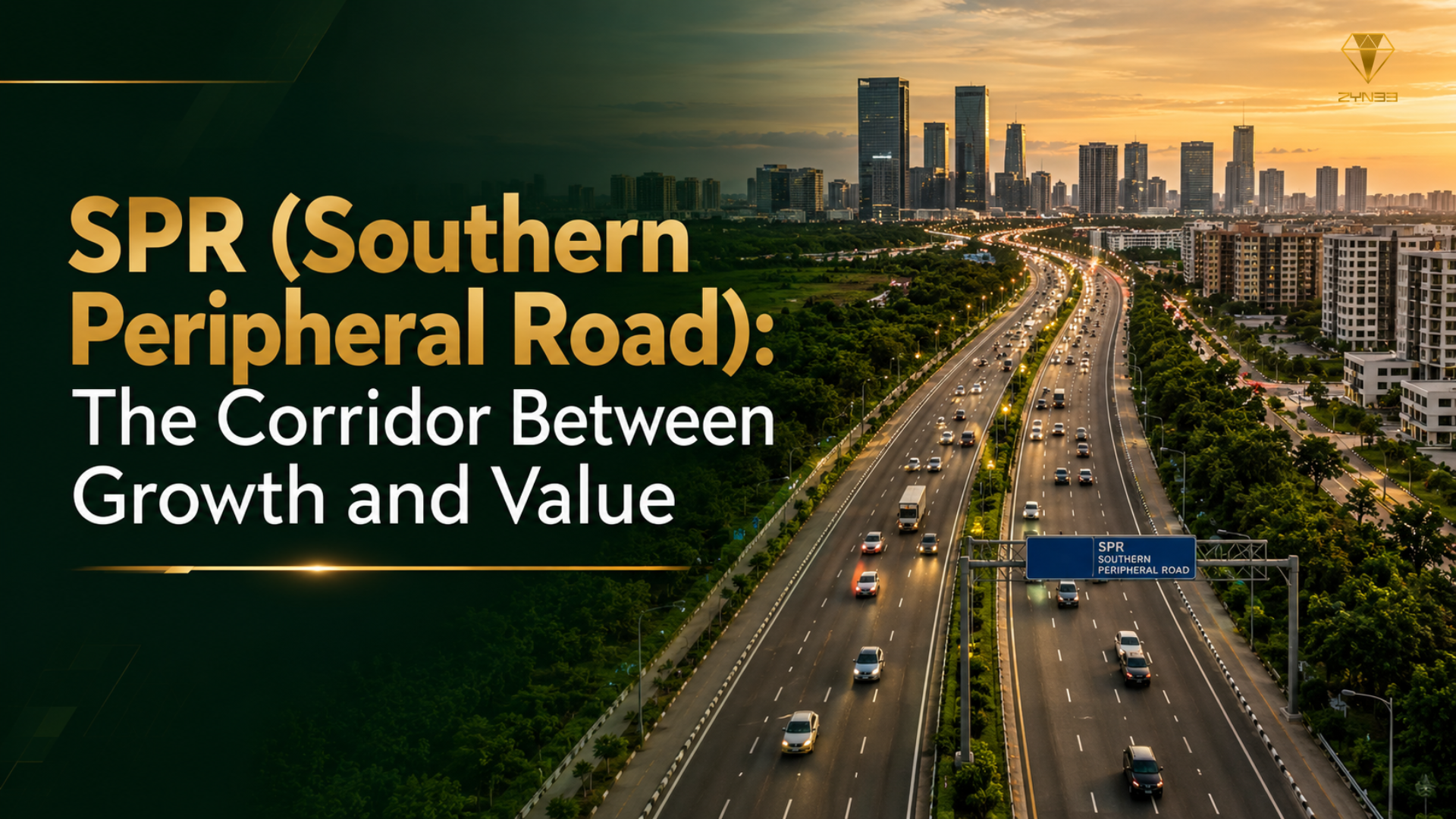
The Southern Peripheral Road upgrade, and it sits inside the usual 2025 to 2028 execution phase. GMDA floated a Rs 755 crore tender in March 2026 for a 4.2 kilometre elevated stretch. That tender was withdrawn.
By June 2026 the authority was inviting consultant bids for a report on 6 kilometres of a 12 kilometre scheme. The design has been reworked since 2019. Construction tenders follow the report, so this is pre-tender, not executing. Indian infrastructure also runs 12 to 24 months behind projection. Our SPR corridor note tracks it.
Not credibly, and here is the test. The Gurugram city print is Rs 15,100 a square foot, up 1.55% on the quarter.
Compound that quarterly across the nine years to 2035 and you get plus 74%. Compound the same number annually and you get plus 15%. The gap between those two readings is larger than most forecasts' entire claimed range, and it comes from one ambiguity in one figure. Any future of Gurgaon real estate projection should state its compounding basis or be ignored.
Cycle Positioning is late expansion with a supply overhang. The city is up 1.55% on the quarter and yields 2.70% on rent of Rs 34 a square foot.
Against that, Gurugram holds roughly 46% of unsold NCR housing stock, near 41,000 units. A market with that overhang does not reprice quickly, whatever the infrastructure does.
By 47 percentage points, which settles the forecasting question. Over the last published year Sector 83 fell 15.84% while Sector 88A rose 31.86%.
Both are in the same city, under the same policy, served by the same corridors. If one year produces that spread between two sectors, a single city-level number for a decade cannot describe what any individual buyer will experience. Pick micro markets Gurgaon by their own prints, which is what our micro market guide does.
Figures use the published city rate and rent, per square foot, with no growth assumed. Illustrative, not guaranteed. A composite illustration, not a client.
At Rs 15,100, Rs 2 Cr buys 1,325 square feet. Let at Rs 34 that is Rs 45,050 a month, or Rs 5.41 lakh a year, which is 2.70% gross and near 1.9% net.
Over nine years to 2035 that rent totals about Rs 48.7 lakh gross before any price change. That figure needs no forecast, which is exactly why it belongs at the centre of a ten year decision instead of a capital projection.
It is the one forward number here with an institution behind it. CBRE puts Gurugram past 100 million square feet of office stock, the largest in north India, heading for 120 to 125 million by 2030.
That implies growth of 20 to 25% over about four years, or roughly 4.6% to 5.7% a year. Demand has also outrun building: the city added 21 million square feet over five years and leased 40 million. For a residential buyer, that employment base is the real long term driver.
Two, and both change your costs now rather than in 2035. Circle rates rose between 10% and 77% by pocket from 1 April 2026, which lifts the stamp duty base on every purchase.
The Haryana affordable housing allotment rate moved to Rs 5,575 a carpet foot in Gurugram on 25 March 2026, a rise of 10 to 12%. Our circle rate note has the pocket detail.
Buy things that pay while you wait. A decade hold means nine years of carrying costs, so rent is the only return you can bank on without a forecast.
Then anchor every purchase to the registered rate for its sector, since that is the recorded floor under your price. Verify the HARERA registration at the authority, not from a listing page. One widely used site repeats a single registration number across four unrelated projects. And insist on carpet area, which HRERA Gurugram Regulation 22 of 2021 requires.
The overhang first, at 46% of NCR unsold stock. Second, infrastructure slippage, which runs 12 to 24 months as a norm and has already sent the SPR upgrade back a stage. Third, divergence, with a 47 point spread between sectors in one year. Fourth, thin yields at 2.70%, which give little cushion across a long hold. Fifth, policy cost, since circle rates can rise again.
Signal: awarded contracts with dates, notified policy, the sector's own print and direction, its rent and registered rate, and the office stock trajectory. Six things and all are checkable. Noise: phase labels with no figures attached. Asset classes that will win, named without prices. A withdrawn tender counted as execution. And any compound number whose basis is unstated.
|
Profile |
Budget |
Horizon |
Action |
|
Income through the hold |
Rs 1.5 Cr plus |
10 yrs |
Highest yielding sector you can verify |
|
Infrastructure led |
Rs 2 Cr plus |
7 yrs |
Sanctioned metro corridor only |
|
Employment led |
Rs 2 Cr plus |
10 yrs |
Near the office growth, not the forecast |
|
Wants a 2035 price target |
any |
any |
Nobody can give you one |
Walk away from any decade projection without a stated compounding basis. Walk away if the SPR upgrade is being sold as under execution. And walk away from a metro premium on a sector with no sanctioned station.
Write it now, in three parts. On price, review when your sector closes to within 10% of the city print of Rs 15,100, which means the discount you bought has gone. On event, sell after the metro opens rather than while it is building. On time, review every three years against rent collected, not against the forecast you bought on.
The future of Gurgaon real estate rests on two contracted things. An office market heading from 100 to 125 million square feet, and a metro due early 2028. Those are contracted. Everything past them is judgement, and should be labelled as such.
What does not stand is the timeline framing. One execution phase scheme has had its tender withdrawn and no figure is attached to any phase. A 47 point spread between two sectors in one year also makes a city-level decade number meaningless. Underwrite on rent, buy the sector rather than the story, and read our Global City progress report for what is genuinely being built.
Strata Capital Holdings tracks price band shifts, infrastructure timelines and inventory movement across Gurugram's corridors. ZYN33 brings that into every allocation conversation.
Market prints. Gurugram city at Rs 15,100 a square foot, up 1.55% quarter on quarter, rent Rs 34, yield 2.70%; Sector 83 down 15.84% and Sector 88A up 31.86% year on year: Square Yards Gurgaon rates, data month June 2026. All asking rates, not registered values. The plus 74% and plus 15% figures are our own compounding of that single 1.55% print over nine years, shown to demonstrate how much the basis matters, and neither is a forecast.
Office market. Past 100 million square feet and largest in north India, heading for 120 to 125 million by 2030, with 21 million added and 40 million leased over five years: CBRE, reported by Business Standard, 23 July 2026. Metro. 28.50 km, 27 stations, Rs 5,452.72 crore: PMO, 7 June 2023, Phase 1 awarded 14 August 2025 on a 30 month deadline. Dwarka Expressway. 29.1 km fully open, tolling from 9 November 2025: PIB and NHAI releases. Global City. Phase 1 acreage and progress: ThePrint, August 2026. Diplomatic Enclave. 34.87 hectares transferred by Cabinet decision of 4 January 2017: Cabinet record. SPR upgrade. Withdrawn Rs 755 crore tender and the consultant stage: The Tribune, 15 March 2026 and Swarajya, 24 June 2026. Policy. Circle rates up 10 to 77% from 1 April 2026, The Tribune, 29 March 2026; affordable allotment rate of Rs 5,575 a carpet foot from 25 March 2026, The Tribune. Unsold stock. Anarock Q2 2026. Carpet area. HARERA Gurugram, Regulation 22 of 2021.
2026 price trends | Emerging micro markets | ROI, the honest math | Gurgaon vs Noida | Where capital wins | Dwarka Expressway price history
Disclaimer
This article is general information about tax and property mechanics in India. It is not tax advice, investment advice or a recommendation to buy a specific property, and it does not account for your personal circumstances. Rates, thresholds and deadlines change. Verify every figure against the source listed above and take your liquidation plan to a qualified chartered accountant before you sell anything. ZYN33 distributes residential projects in Gurugram and is paid a transaction fee when a purchase completes. We do not act as your tax adviser or your adviser on the equity side.
Tell us your budget and timeline.
Tell us your budget and timeline.