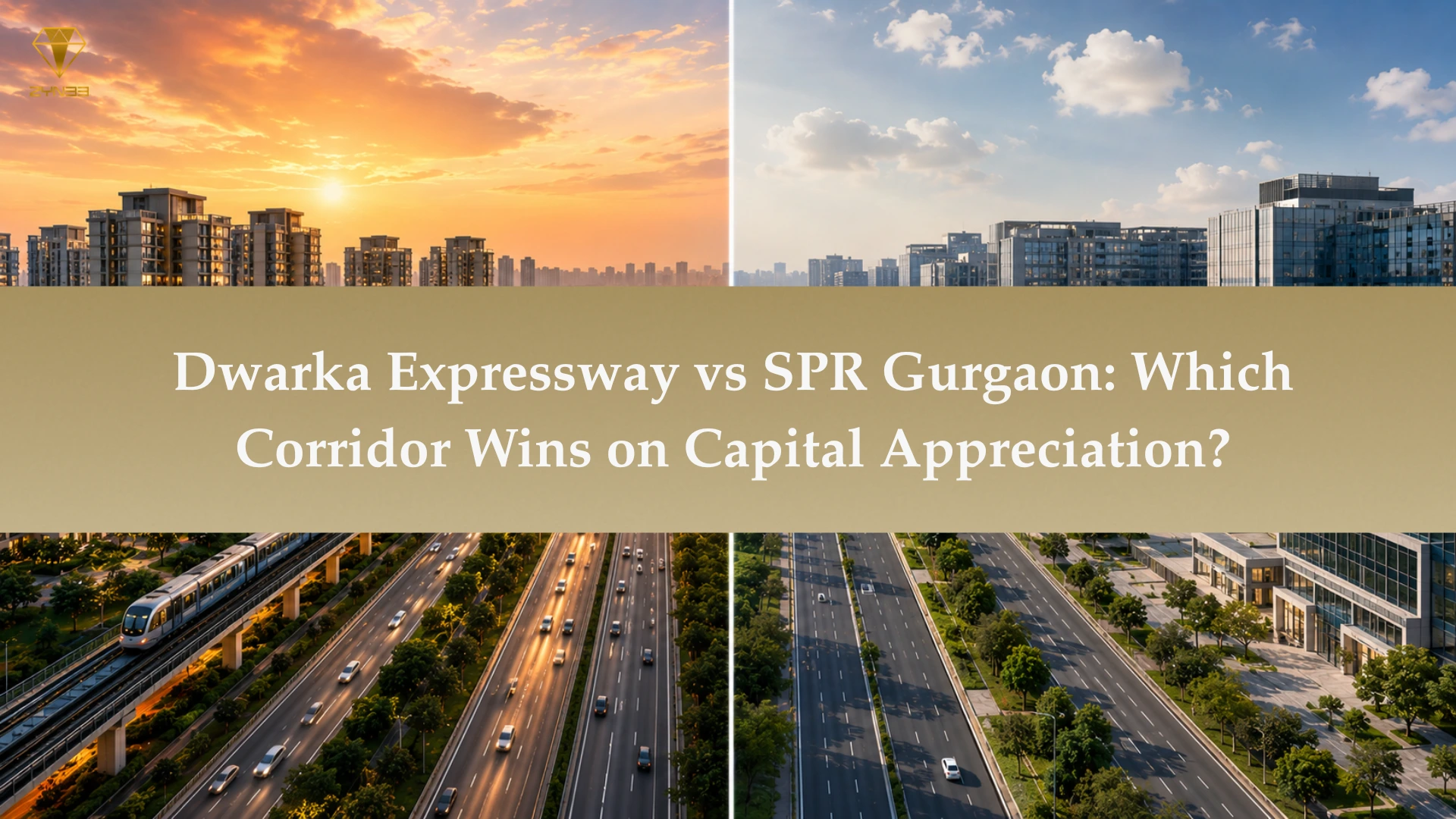
Dwarka Expressway and SPR Gurgaon are both positioned for strong real estate growth in 2026, but they suit different investor profiles. Dwarka Expressway offers airport connectivity, luxury inventory, and post-trigger stability, while SPR provides stronger pre-trigger appreciation potential, rental demand, and Golf Course Road access. Both corridors can deliver 12–18% annual returns over the next 5–6 years. The right choice depends on budget, hold period, lifestyle priorities, and risk appetite rather than headline appreciation numbers alone.
Most investors framing the choice between property in dwarka expressway and Southern Peripheral Road in 2026 are running the wrong analysis. They look at corridor-level appreciation averages, pick the higher number, and book. The averages hide more than they reveal. The two corridors sit at different cycle stages, attract different buyer profiles, carry different infrastructure trigger calendars, and deliver appreciation through different mechanisms. The right question is not which corridor is better. It is which corridor matches your specific capital, hold period and risk appetite.
Dwarka Expressway delivered a 58 percent year on year surge in Q4 2024 to Q1 2025 and a cumulative 200 percent appreciation between 2016 and 2026. SPR has moved from Rs 7,690 per sq ft in 2020 to roughly Rs 18,000 per sq ft by mid-2024, a 130 percent appreciation in five years. Both numbers are real. Both are misleading without the cycle-stage context. Here is the comparison that actually matters for your capital.
|
Your Situation |
What to Do |
|
Rs 2 Cr to Rs 3.5 Cr, want highest IRR, 4 to 6 year hold |
SPR mid-construction or Dwarka Expressway mid-value belt |
|
Rs 3.5 Cr to Rs 5 Cr, premium with airport priority |
Dwarka Expressway premium core (Sector 103, 104, 109) |
|
Rs 3.5 Cr to Rs 5 Cr, premium with Golf Course access priority |
SPR premium sectors (76 to 78, 84, 85) |
|
Rs 5 Cr plus, luxury appreciator, lifestyle priority |
Dwarka Expressway Delhi border luxury (111, 113, 114) |
|
Sub 24 month flip expectation |
Neither. Both corridors favour 4 to 6 year holds in 2026. |
If this is not you, stop here.
Dwarka Expressway. The 29 km corridor became fully operational in June 2025 after a Rs 9,000 crore investment. Average flat rates currently sit around Rs 14,000 per sq ft, with premium pockets at Rs 18,000 to Rs 26,000 and ultra-luxury branded crossing Rs 28,000. Flat appreciation has run 12 percent over the last 12 months, 75 percent over three years and 152 percent over five years per 99acres data. Knight Frank, Anarock and CBRE project annual appreciation of 12 to 18 percent through 2028 and cumulative 40 to 60 percent by 2030.
SPR (Southern Peripheral Road). The corridor connects Golf Course Extension Road to NH-48 and serves as a critical link in Gurgaon's internal infrastructure network. Pricing moved from Rs 7,690 per sq ft in 2020 to approximately Rs 18,000 per sq ft by mid-2024, a 130 percent gain over five years. Sector 76 specifically saw a premium project move from Rs 10,500 per sq ft in 2023 to Rs 17,250 per sq ft, a 64 percent gain in around 12 months. Projected annual appreciation through 2028 to 2029 sits at 12 to 18 percent per Housivity and DLF Homes commentary, with capital appreciation of 15 to 25 percent expected post-metro completion.
Circle rate signal. Gurgaon's April 2026 circle rate revision raised official rates by up to 75 percent across the city. SPR sectors 63, 63A, 64 and 67 saw residential rates rise by 45 percent to Rs 84,825 per sq yard. Sectors 62, 65, 66 and 69 to 72 saw 30 percent increases to Rs 91,000 per sq yard. Dwarka Expressway sectors saw comparable revisions, with circle rates projected to rise up to 67 percent toward Rs 7,000 per sq ft. Both corridors are now treated by the administration as mature growth markets rather than speculative spillover zones. That recognition matters for the forward case.
Both corridors moved through similar acceleration phases between 2020 and 2024. They diverge meaningfully in 2026.
Dwarka Expressway cycle position: Mid-to-late maturity. The Q4 2024 to Q1 2025 surge was the corridor's structural reset event. Infrastructure (expressway operationalisation) is complete. Metro Blue Line extension confirmed for the 2026 to 2027 window is the next major trigger. Buyer profile has shifted to end-user dominant. The corridor in 2026 is a precision play, not a discovery play.
SPR cycle position: Mid-expansion. The corridor sits roughly 18 to 24 months behind Dwarka Expressway on the same trajectory. Major infrastructure triggers (metro extension to Cyber City spur, road widening, signal-free corridors, RRTS) are confirmed but not yet operational. Premium developer launches (DLF, M3M, Ganga, Anantam) have accelerated through 2024 and 2025. The cluster between Golf Course Extension Road and NH-48 still trades at meaningful discounts to comparable Dwarka Expressway premium core inventory.
The cycle gap is the trade. SPR offers what Dwarka Expressway offered in 2023. Dwarka Expressway offers what SPR will offer in 2027 to 2028. Whether you want pre-trigger exposure or post-trigger stability is the most important question driving the comparison.
|
Parameter |
Dwarka Expressway |
SPR Gurgaon |
|
Average mid-segment pricing |
Rs 14,000 per sq ft |
Rs 13,000 to Rs 18,000 per sq ft |
|
Premium pricing |
Rs 18,000 to Rs 26,000 per sq ft |
Rs 17,000 to Rs 22,000 per sq ft |
|
5-year cumulative appreciation |
152 percent (flats) |
130 percent |
|
Forward annual appreciation (2026-2028) |
12 to 18 percent |
12 to 18 percent, with post-metro 15 to 25 percent uplift |
|
Rental yield range |
2.5 to 5 percent |
3 to 4.5 percent (3 BHK Rs 28k to Rs 45k per month) |
|
Cycle stage |
Mid-to-late maturity |
Mid-expansion |
|
Primary infrastructure trigger |
Metro Blue Line extension 2026-27 |
Metro to Cyber City spur, RRTS, signal-free corridors |
|
Key connectivity advantage |
IGI Airport in 15 to 20 minutes |
Golf Course Road, Cyber City, Sohna Road |
|
Dominant buyer profile |
End-user, NRI, branded residence buyer |
Working professional, mid to premium investor |
|
Supply concentration risk |
High in Sectors 102 to 109 |
Moderate, more evenly distributed |
Mid-Value Belt (Sectors 102, 106, 108)
Entry Price: Rs 11,000 to Rs 17,000 per sq ft. Rental Yield: 3.5 to 4.5 percent. Capital Appreciation: 12 to 15 percent over 24 to 36 months. Godrej Meridien, Godrej Vrikshya, Sobha City Gurgaon and Sobha Altus anchor this band. The metro Blue Line extension is the structural trigger. This cluster offers the cleanest risk-adjusted entry on Dwarka Expressway in 2026.
Premium Core (Sectors 103, 104, 109)
Entry Price: Rs 15,500 to Rs 22,000 per sq ft. Rental Yield: 3 to 3.5 percent. Capital Appreciation: 8 to 10 percent annual. Central Park 104, Hero Homes The Palatial, Whiteland Westin Residences anchor this cluster. The investment case here is stable end-use appreciation with airport-proximity premium.
Delhi Border Luxury (Sectors 111, 113, 114)
Entry Price: Rs 15,000 to Rs 26,000 per sq ft, branded crossing Rs 28,000. Rental Yield: 2.5 to 3.5 percent. Capital Appreciation: 25 to 35 percent over 4 years on spread compression to Golf Course Road. M3M Crown, M3M Capital, M3M Mansion, M3M Elie Saab Residences, M3M Antalya Hills and Sobha Aranya occupy this cluster. The thesis is spread compression against Golf Course Road luxury.
Affordable Cluster (Sectors 37D, 88A, 99, 99A)
Entry Price: Rs 8,000 to Rs 13,000 per sq ft. Rental Yield: 4 to 5 percent. Capital Appreciation: 12 to 18 percent annual potential over 5 to 7 years. Signature Global City 37D, Signature Global Twin Tower DXP, Lotus Homz, ROF Alante, Hero Homes Gurgaon, Signature Global The Millennia, Pareena Laxmi Apartments and Pivotal Riddhi Siddhi Apartments offer entries in this band with developer-specific execution risk.
SPR Premium Sectors (76, 77, 78, 84, 85)
Entry Price: Rs 15,000 to Rs 22,000 per sq ft. Rental Yield: 3.5 to 4.5 percent. Capital Appreciation: 12 to 18 percent annual, with post-metro 15 to 25 percent uplift. DLF has launched two major residential projects along this stretch, both of which saw immediate post-launch appreciation. Ganga Realty's Nandaka 84 and Anantam 85 anchor the premium new launches. Sector 76 already demonstrated a 64 percent appreciation in a 12-month window post-launch. The investment thesis is direct Golf Course Road proximity plus Cyber City access.
SPR Mid-Premium Sectors (68 to 75)
Entry Price: Rs 13,000 to Rs 17,000 per sq ft. Rental Yield: 3.5 to 4.5 percent. Capital Appreciation: 12 to 15 percent annual through cycle. Multiple mid-premium launches and resale inventory. End-user demand from working professionals across Cyber City, Udyog Vihar, and Sohna Road job clusters. 3 BHK rental rates of Rs 28,000 to Rs 45,000 per month support the yield profile.
SPR Commercial and SCO Belt
SPR has emerged as one of Gurgaon's strongest commercial SCO and high-street retail markets. Commercial yields run at 6 to 7 percent. The corridor's commercial maturation supports residential rental demand from business owners and professionals operating from SPR offices and retail spaces. The residential plus commercial flywheel is a structural advantage SPR carries that Dwarka Expressway is still building.
The clearest way to read dwarka expressway vs SPR is to deploy the same capital across both and compare the math.
Scenario A: Rs 3 Cr in Dwarka Expressway Sector 102 or 106, 5 year hold ahead of metro trigger. Entry at Rs 14,000 per sq ft for a 2,100 sq ft 3 BHK. Projected exit at Rs 21,500 per sq ft post-metro repricing, producing an exit value of Rs 4.5 Cr. Rental income of Rs 65,000 to Rs 85,000 per month from year two. Net IRR range: 12 to 15 percent.
Scenario B: Rs 3 Cr in SPR Sector 76 or 84, 5 year hold ahead of metro and RRTS trigger. Entry at Rs 16,500 per sq ft for an 1,800 sq ft 3 BHK. Projected exit at Rs 26,000 per sq ft post-metro and infrastructure completion, producing an exit value of Rs 4.7 Cr. Rental income of Rs 60,000 to Rs 80,000 per month. Net IRR range: 13 to 16 percent.
Scenario C: Rs 5 Cr split equally across both corridors (Rs 2.5 Cr each), 6 year hold. Rs 2.5 Cr in Dwarka Expressway mid-value belt produces an exit value of approximately Rs 3.9 Cr. Rs 2.5 Cr in SPR Sector 76 to 78 produces an exit value of approximately Rs 4.0 Cr. Combined exit: Rs 7.9 Cr. Net portfolio IRR: 12 to 14 percent. The diversification reduces single-corridor risk without giving up materially on return.
The scenarios reveal something important. Both corridors deliver comparable forward IRR for similar capital deployment in 2026. The difference is in which trigger you are betting on and which lifestyle profile the buyer prioritises.
|
Profile |
Budget |
Best Corridor |
Reason |
|
NRI or frequent flyer |
Rs 3 Cr to Rs 6 Cr |
Dwarka Expressway |
IGI Airport in 15 to 20 minutes |
|
Cyber City or Golf Course Road professional |
Rs 2 Cr to Rs 4 Cr |
SPR |
10 to 15 minute office commute |
|
Pre-trigger appreciation investor |
Rs 2.5 Cr to Rs 4 Cr |
SPR mid-construction |
Cycle stage advantage of 18 to 24 months |
|
Branded luxury appreciator |
Rs 6 Cr plus |
Dwarka Expressway luxury |
Branded residence depth and spread compression |
|
Diversification-led investor |
Rs 5 Cr plus |
Split across both |
Different trigger calendars reduce concentration risk |
Who should avoid Dwarka Expressway in 2026. Investors expecting a repeat of the Q4 2024 to Q1 2025 surge. That structural reset is not repeating. Buyers with maximum leverage and no cash flow buffer for the 6 to 9 month gap between possession and lease stabilisation on luxury inventory. Capital allocators looking for sub-24-month flips; secondary market liquidity has tightened on under-construction inventory through 2026. Investors anchoring on Sector 113 luxury pricing as a comparison benchmark for Rs 3 Cr capital, because the Delhi border luxury cluster occupies a different market category from mid-value belt inventory.
Who should avoid SPR in 2026. Investors prioritising airport proximity as the primary driver; SPR is 40 to 60 minutes from IGI versus 15 to 20 minutes from Dwarka Expressway. Buyers expecting the same volume of branded residence inventory available on Dwarka Expressway; SPR's branded residence depth is materially smaller. Capital seeking ultra-luxury ticket sizes above Rs 8 Cr in dedicated branded clusters; the corridor's luxury cap currently runs lower than Dwarka Expressway's Sector 113 ceiling. Buyers who need ready possession across all configuration sizes; SPR's ready inventory is more concentrated in 3 BHK formats than in the 4 BHK plus segment.
|
What Matters |
What Is Noise |
|
Cycle stage gap between the two corridors |
Headline cumulative appreciation comparisons |
|
Confirmed infrastructure trigger timing and proximity |
Unconfirmed metro or expressway extensions |
|
Buyer's primary destination (airport vs Cyber City vs Golf Course) |
Generic "connectivity" claims without route specifics |
|
Developer's documented delivery history in the specific corridor |
Brand recognition from a different micro-market |
|
Supply concentration in the entry cluster |
Corridor-wide supply averages |
|
Circle rate revision impact on stamp duty for new entry |
Pre-revision price comparisons |
Each corridor carries a distinct timing trigger calendar through the next 24 to 36 months.
Dwarka Expressway triggers. Metro Blue Line extension from Dwarka Sector 21 to Kherki Daula, confirmed for 2026 to 2027 operational. Sectors 102, 103, 104 and 109 are projected to see 15 to 20 percent appreciation on metro operationalisation. Diplomatic Enclave activation near Dwarka Sector 24 is a longer-cycle catalyst for premium residences. Yashobhoomi Convention Centre maturity drives hospitality demand for branded inventory.
SPR triggers. Metro corridor from Millennium City Centre to Cyber City with a 1.8 km spur reaching Dwarka Expressway, currently in execution. RRTS connectivity is in planning. Multiple flyovers, signal-free corridors and road widening projects are scheduled for completion through 2027. Premium SCO and commercial absorption continues to compound residential demand. SPR gurgaon investment capital is positioned for these triggers to deliver sequentially.
Shared trigger: circle rate revision. April 2026 circle rate increases of 30 to 75 percent across Gurgaon corridors raise stamp duty costs for future buyers. Entry at current rates carries a meaningful effective discount versus entry post-rate revision absorption. This trigger compresses the entry window equally across both corridors.
For Dwarka Expressway entries. Target tier-1 developer inventory below Rs 14,500 per sq ft in Sectors 102, 106, 108 for mid-value belt. Below Rs 21,000 per sq ft for premium core ready or near-possession. Configuration 1,800 to 2,200 sq ft for 3 BHK optimal liquidity. For luxury, M3M Crown, M3M Capital, M3M Mansion, M3M Elie Saab Residences, Sobha Aranya at configurations between 2,500 and 3,200 sq ft.
For SPR entries. Premium sectors (76, 77, 78, 84, 85) below Rs 17,500 per sq ft for under-construction 30 to 70 percent complete. Mid-premium (68 to 75) below Rs 15,000 per sq ft for similar construction stage. Developer filter is critical because the corridor has attracted both credible and undercapitalised launches in the past 18 months. DLF projects, Ganga Realty's Nandaka 84 and Anantam 85 carry tier-1 track records. Stick to RERA-registered launches with 30 percent or more construction visible.
For diversified entries. Split capital across both corridors with budget weighting toward the cycle stage best suited to your hold period. Pre-trigger entries (SPR) work best with 5 to 7 year holds. Post-trigger entries (Dwarka Expressway premium core) work best with 4 to 6 year holds and end-use overlay. Avoid splitting capital below Rs 5 Cr ticket sizes; the transaction cost drag erodes the diversification benefit.
Dwarka Expressway primary risk. Paying for the 2024 to 2025 surge. Premium core and Delhi border luxury inventory has re-priced aggressively in response to the surge. Entry above Rs 22,000 per sq ft for non-branded Sector 103 and 104 inventory needs specific project justification, not corridor momentum. Supply concentration in Sectors 102 to 109 also creates absorption pressure post-possession.
SPR primary risk. Infrastructure timeline slippage. The corridor's forward case rests heavily on metro execution, RRTS development, and adjacent infrastructure completion. Each carries its own delivery uncertainty. The metro spur to Dwarka Expressway is expected to commence operations within 30 months but Indian metro projects routinely run behind schedule. Build a 12 to 18 month timeline buffer into IRR calculations.
Shared risk: supply absorption. Both corridors have seen elevated developer activity through 2023 to 2025. Q3 to Q4 2025 showed particularly strong launch activity. Investors entering must filter for project-specific absorption rather than corridor-wide narratives. A weak tier-2 launch in either corridor underperforms a tier-1 launch in the other corridor at similar pricing.
Shared risk: interest rate volatility. RBI guidance and mortgage rate movements directly affect buyer affordability across both corridors. Rate increases through 2026 to 2027 could moderate demand at the marginal buyer level. The mitigation is targeting end-user dominant projects rather than investor-heavy launches.
Price-based exit on Dwarka Expressway. Mid-value belt entries at Rs 13,000 to Rs 15,000 per sq ft target exit at Rs 20,000 to Rs 23,000 per sq ft over 5 to 6 years. Premium core entries at Rs 18,000 to Rs 22,000 per sq ft target exit at Rs 28,000 to Rs 32,000 per sq ft over 6 to 7 years.
Price-based exit on SPR. Premium sector entries at Rs 16,000 to Rs 18,000 per sq ft target exit at Rs 26,000 to Rs 30,000 per sq ft over 5 to 6 years post-metro completion. Mid-premium entries at Rs 13,000 to Rs 15,000 per sq ft target exit at Rs 20,000 to Rs 24,000 per sq ft over the same horizon.
Event-based exit. Dwarka Expressway exits position around metro Blue Line operationalisation in 2026 to 2028. SPR exits position around metro spur completion and RRTS activation, expected in the 2027 to 2029 window. Both events create 2 to 3 quarters of heightened secondary market liquidity.
Time-based exit. For under-construction entries in either corridor, target exit at possession plus 18 to 24 months. The project matures into a recognised address, rental benchmarks are documented, and resale liquidity strengthens versus possession itself. Forced exits at possession on either corridor give up 10 to 15 percent of available upside.
Neither corridor wins the SPR vs dwarka expressway returns comparison in absolute terms. Both deliver comparable forward IRR in the 12 to 18 percent range for similar capital deployment in 2026. The decision is not about which corridor produces higher returns. It is about which corridor matches your profile.
Choose Dwarka Expressway if airport proximity, branded residence depth, or post-trigger stability matter most. The corridor offers the more mature ecosystem, the deeper luxury inventory pool, and the stronger NRI buyer profile. Forward returns through 2030 are anchored by metro operationalisation, Diplomatic Enclave activation and spread compression to Golf Course Road.
Choose SPR if Golf Course Road proximity, Cyber City commute, or pre-trigger cycle stage matter most. The corridor offers stronger rental yield positioning, working professional tenant pool depth, and 18 to 24 months of cycle stage advantage in catching the next infrastructure repricing event.
For Rs 5 Cr plus capital with disciplined diversification appetite, splitting between both corridors hedges single-trigger risk without giving up materially on aggregate IRR. For all other capital profiles, the cleaner trade is corridor specialisation matched to lifestyle and trigger preference. The right corridor is the one that matches your specific profile, not the one with the higher headline appreciation number.
If your capital sits between Rs 2 Cr and Rs 8 Cr and your decision window is the next 60 to 90 days, ZYN33 maps live pricing, infrastructure trigger timelines and tier-1 developer inventory across both Dwarka Expressway and SPR. We work with decision-ready buyers who want corridor-comparison intelligence before committing capital. Strata Capital Holdings tracks the underlying data on both corridors; ZYN33 converts informed intent into transactions on property in dwarka expressway and SPR investments alike.
Dwarka Expressway Gurgaon is not one single market. Every sector operates in a different price cycle, supply stage, and return profile. Affordable clusters like Sector 37D, 88A, and 99A offer higher upside with longer holding periods, while Sectors 102, 106, and 108 provide balanced appreciation and rental yield. Premium sectors 103, 104, and 109 suit stable end-use buyers, whereas Sectors 111 to 114 target luxury investors seeking branded residences and long-term capital growth. The right investment depends on budget, holding period, and sector positioning—not just project pricing.
View More
Dwarka Expressway 3 BHK market in 2026 offers options from affordable to luxury segments across key sectors like 103, 104, 106 and 108. This guide explains pricing, layouts, rental yield, appreciation potential and top projects for different budgets. Buyers should focus on sector growth cycle, developer track record and layout efficiency before selecting a property. Mid-value and premium sectors continue to show strong long-term investment potential with metro-driven growth ahead.
View More
Dwarka Expressway has become one of the fastest-growing luxury real estate destinations in Gurgaon. Premium apartments in this location offer modern amenities, excellent connectivity, and strong investment potential. With rising infrastructure development, proximity to business hubs, and increasing demand for upscale living, luxury properties here attract both homebuyers and investors. From spacious layouts to high-end lifestyle features, Dwarka Expressway delivers the perfect mix of comfort, convenience, and long-term returns.
View More
Dwarka Expressway properties in 2026 have moved from a speculative growth story to a structured mid-cycle investment opportunity. While the explosive appreciation phase has passed, sectors like 102, 106, 103, 104, 111, 113, and 114 still offer strong potential based on connectivity, metro expansion, airport access, and infrastructure growth. Investors with a 4–6 year horizon can benefit from sector-specific opportunities, rental yield growth, and long-term capital appreciation through disciplined developer and pricing selection.
View More
Sector 88A in Gurugram is emerging as a smart choice for homebuyers looking for affordable housing with strong connectivity. Located near the Dwarka Expressway, the area offers budget-friendly residential projects like Adani Aangan and Breez Global Heights that combine practical layouts, essential amenities, and future growth potential.
View More
Gurgaon’s 3 BHK market in 2026 offers strong opportunities for end-users and investors across Sohna Road, Dwarka Expressway, Golf Course Extension, and Golf Course Road. Each corridor suits different budgets, rental yields, and appreciation goals. The guide highlights the importance of corridor selection, market cycle, pricing trends, and hold period before investing. Buyers focusing on long-term growth, rental income, and infrastructure-driven appreciation can find strong value in the right 3 BHK project with ZYN33 Real Estate.K flats in Gurgaon 2026: corridor pricing, ROI, and buyer's logic for capital between Rs 1.5 Cr and Rs 7 Cr deployed in 90 days.
View More
Sector 71 Gurgaon is entering a critical investment phase driven by Dwarka Expressway completion, upcoming metro connectivity, and Global City development. Prices have risen sharply but still offer a gap versus established corridors. With ₹3–7 crore capital and a 3–7 year horizon, investors can benefit from the second growth cycle. Acting before metro operations and collector rate hikes is key, while careful developer due diligence remains essential.
View More
Sector 108 Gurgaon has emerged as a prime luxury investment destination along Dwarka Expressway. With branded projects, fast connectivity to Delhi and the airport, and steady price appreciation, it offers strong potential for long-term capital growth and premium living.
View More
The under-Rs 2 Crore 3 BHK market in Gurgaon is tightening as developers shift toward higher-priced launches. In 2026, genuine options exist mainly across three clusters: SPR, Dwarka Expressway, and New Gurgaon Sector 83. Projects like Unitech South Park, Mahindra Aura, Tulip Orange, Mapsko Paradise, and Sobha Altus offer different combinations of yield, growth, and end-use value. Buyers must evaluate carpet ratio, rental demand, corridor maturity, and RERA compliance before investing in this highly competitive segment.
View More