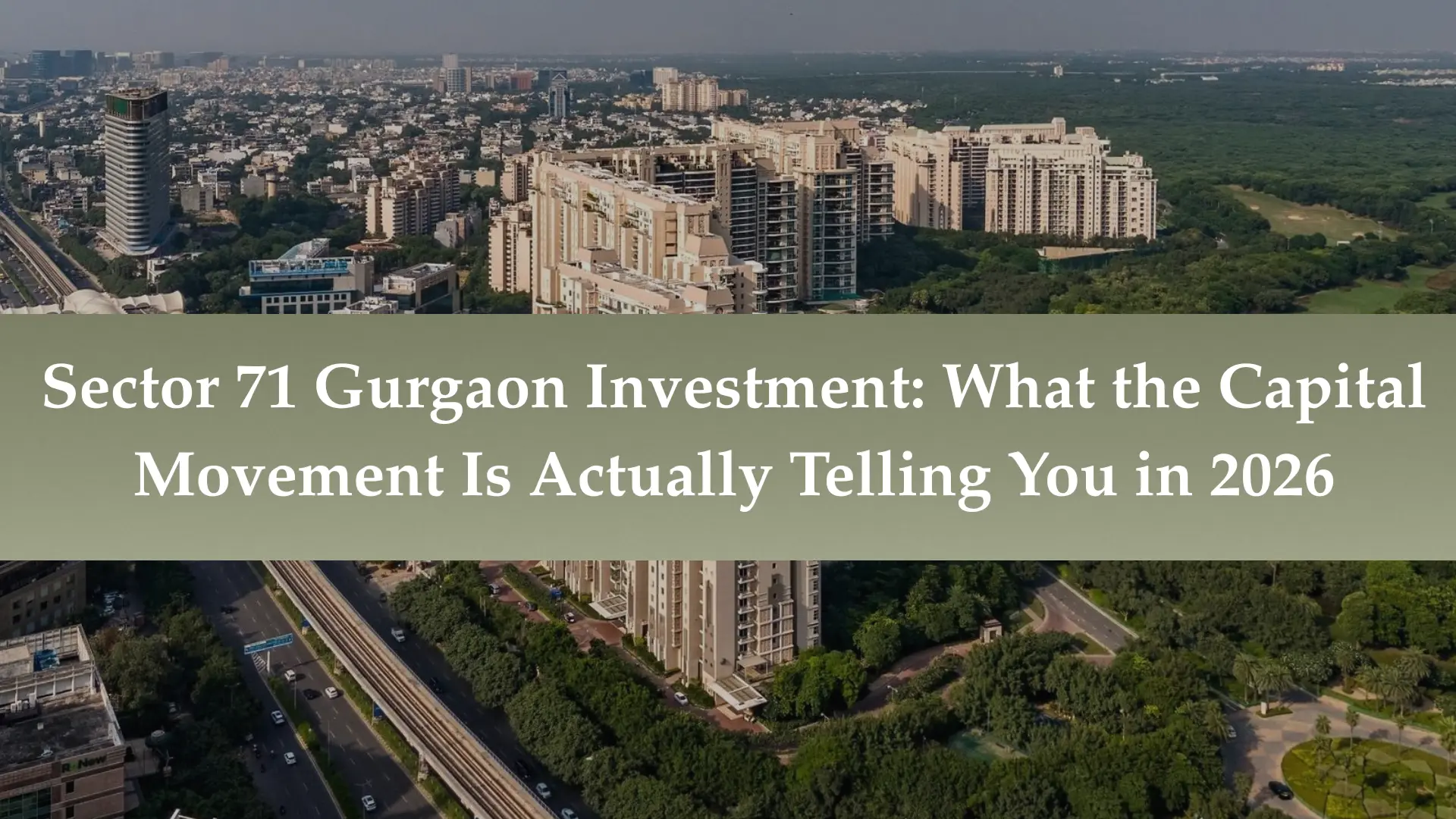
The five year numbers on Dwarka Expressway are spectacular and nearly useless. Asking rates are up 152 percent over five years, but Sector 79 is down 1.2 percent over the last twelve months and Sector 84 is up 1.5. The corridor did not stop growing everywhere at once, it stopped in the cheap part first. This guide covers what each cluster actually asks, what the net IRR looks like with and without rent, why the metro cost doubled without a published completion date, and which third of the corridor to avoid.
Written by Mansi Joshi, Marketing Intelligence Lead, ZYN33 Investment Desk. Reviewed by Ritesh Arora, Founder, ZYN33 and Strata Capital Holdings, Gurugram. Advising on Gurugram residential capital allocation since 2023, with mandates ranging from Rs 3 Cr to Rs 50 Cr. Published 21 June 2026. Last reviewed 30 August 2026.
Disclosure: ZYN33 distributes residential projects in Gurugram and is paid a transaction fee when a purchase completes, including on projects we discuss with you. We do not give tax advice. This post is general information. Take it to your chartered accountant.
Wealth is compounding. Absorption is not. Anarock recorded residential sales across India's top seven cities down 6 percent year on year in Q2 2026 while launches rose 7 percent.
That changes which mistake is expensive. Until last year the costly error was hesitation. In 2026 it is indiscriminate deployment. Family office real estate investment India decisions built on the 2021 playbook now meet a different market. Exit depth, not entry price, decides the return.
Only with a written allocation policy, and only on a seven year view. Four situations decide it.
First sleeve of Rs 20 Cr to Rs 50 Cr? Anchor in built out trophy stock, add one growth corridor asset, two developers minimum. Already 70 percent residential? Stop adding apartments, route new capital into tenanted commercial. Need income inside four quarters? Under construction residential fails you.
If the trigger is a developer pitching an allotment window, do not enter. Scarcity framing is a sales instrument. If this is not you, stop here.
Wide, and disputed by the people who publish them. One label before any number. Consultancy and portal series are built on quoted and launch pricing, so every band below is an asking rate on super built up area. Registered rates sit lower. A rate without a stated basis is not a rate.
For UHNW real estate India allocations the spread matters more than the average. Anarock puts Gurgaon residential near Rs 6,150 per sq ft in Q1 2020 and Rs 11,300 by Q1 2025. Magicbricks PropIndex tracked a sharper move to around Rs 14,650. They disagree because they weight different sectors, and that is the finding. Corridor selection produced the returns, not city selection.
Golf Course Road sits near Rs 27,000 per sq ft, effectively built out, almost all inventory arriving through resale. Golf Course Extension prints Rs 18,900 to Rs 22,800. Dwarka Expressway runs Rs 11,000 to Rs 20,000. Residential gross yields sit at 2.5 to 4.7 percent, against 6 to 11 percent on Grade A office and quality retail.
On our mandates this year, the gap between asking and the registered comparable in the same tower was the largest source of avoidable overpayment.
Yes for scarcity and cash flow, no for volume plays in fresh supply. Cycle Positioning at the macro level is benign but no longer accommodative.
The RBI held the repo at 5.25 percent on 5 August 2026, a fourth consecutive hold, stance neutral. It raised FY27 GDP to 6.7 percent and trimmed CPI to 5.0 percent, while flagging a near term peak of 5.9 percent. June CPI hit 4.4 percent, the first reading above target in seventeen months. Neutral means no direction has been signalled, so model no further easing.
The micro picture splits three ways. Built out corridors sit in stabilisation, land scarce and resale deep. Growth corridors are mid expansion. Pre maturity is infrastructure complete and demand light, which is where the Q2 supply signal bites.
Across four sleeves, sized by policy before any site visit. That is what real estate portfolio allocation India looks like when designed rather than accumulated.
Built out anchor, 40 to 50 percent. Golf Course Road and DLF Phase 5. Entry Price (asking): Rs 25,000 to Rs 35,000 per sq ft. Rental Yield: 2.5 to 3.5 percent. Capital Appreciation: 8 to 12 percent. The thesis is exit certainty, not return. This corridor cannot be supplied into, so it is the only address that reliably releases Rs 20 Cr in a quarter.
Active growth, 30 to 40 percent. Golf Course Extension Sectors 63A to 67, plus delivered Dwarka Expressway. Entry Price (asking): Rs 15,000 to Rs 23,000. Rental Yield: 3.5 to 4.7 percent. Capital Appreciation: 12 to 18 percent. Gurgaon luxury real estate investment gives its best blended profile here, because tenant demand is resident rather than projected.
Pre-leased commercial, the underweight sleeve. Grade A offices, SCO in Sectors 82 and 114, tenanted retail. Entry Price (asking): Rs 15,000 to Rs 27,000. Rental Yield: 6 to 11 percent, the top band needing a blue chip lessee on a long lock in. Global Capability Centres drive 40 to 50 percent of Grade A leasing, so demand is structural. Pre-leased commercial property in Gurgaon is the fastest route to lifting blended yield, and we set out the tenant and lease tests in our investor read on pre-leased assets.
Pre-maturity tactical, cap at 10 to 20 percent. SPR, New Gurgaon Sectors 82 to 89, Sohna. Entry Price (asking): Rs 12,000 to Rs 17,000. Rental Yield: 3.8 to 4.5 percent. Capital Appreciation: 14 to 18 percent if triggers land. Size it so a three year slip is an irritation.
Low double digits net. A Rs 50 Cr allocation of Rs 22 Cr trophy, Rs 18 Cr growth and Rs 10 Cr tenanted SCO blends to roughly 4.4 percent gross, about Rs 2.2 Cr of rent a year. Modelled net IRR: 11 to 13 percent. Carry Rs 30 Cr of commercial in a Rs 100 Cr allocation and it blends nearer 6 percent gross and 13 to 15 percent net. The commercial weighting moves that, not the trophy.
Disclosure: ZYN33 is a Strata Capital Holdings brand and transacts as a distributor. Several developers active in the corridors above sit in our catalogue, and we earn on completed bookings. These scenarios illustrate allocation shape. They are not project recommendations, and every yield, appreciation and IRR figure here is a modelled assumption rather than a forecast.
|
Profile |
Budget |
Hold |
Action |
|
First time entrant |
Rs 20 Cr to Rs 50 Cr |
7 to 10 years |
60 percent built out, 40 percent growth |
|
Yield deficient portfolio |
Rs 50 Cr to Rs 200 Cr |
10 years plus |
Shift 30 percent into tenanted commercial first |
|
Multi generational holder |
Rs 100 Cr plus |
15 years plus |
Trust ownership, scarcity led addresses |
|
Tactical allocator |
Rs 10 Cr to Rs 30 Cr |
5 to 7 years |
Pre maturity only, capped hard |
Three groups. If property already represents 60 percent or more of family wealth, more Gurgaon residential is concentration, not diversification.
If your committee needs quarterly liquidity, property will not deliver it. Friction runs 7 to 12 percent in, around 3 percent out, plus 12.5 percent capital gains. On a three year hold that stack eats the appreciation.
If succession is unresolved, a large single asset creates estate complications that outlast the return. And if the trigger was whichever developer called last, your portfolio is being built by their distribution team.
Four things, none of which appear in a pitch deck. Whether the allocation policy was signed before any site visit. Net IRR after duty, drag and tax, not headline appreciation. Resale depth in the specific project, not the corridor. Trust structure and Section 54EC sequencing agreed before the first booking.
What does not decide it: developer relationship depth, citywide growth narratives, launch day absorption claims, or a tax saving asserted without legal architecture.
Sector by sector, because all four live triggers move pockets rather than the city.
Collector rates reset the official floor on 1 April 2026. Read the detail, not the headline. The Deputy Commissioner's statement of 2 April puts the average rise at 15 to 30 percent. Roughly 11 percent of the district rose as much as 75 percent, and about 51 percent did not move. Not a citywide repricing. We broke it down in our note on the 2026 circle rate revision.
Global City Phase 1 is targeted for December 2026, occupancy realistically 2028 to 2029. Targeted is not confirmed, so carry the slippage. The Gurugram metro loop runs 28.5 km with 27 stations and Phase 2 tendered in 2026. Fourth, watch quarterly GCC net absorption, which underwrites the commercial sleeve. Our corridor read sits in our Dwarka Expressway sector guide.
Before the first booking, never after, because retrofitting after registration means paying duty twice. Private trusts and HUFs remain standard.
Long term capital gains run at 12.5 percent without indexation for transfers on or after 23 July 2024. Residents and HUFs who acquired before that date may opt for 20 percent with indexation. That option covers neither non residents nor anything bought now.
Two caps bind quickly here. Section 54 reinvestment relief is capped at Rs 10 crore of gains, Section 54EC bonds at Rs 50 lakh per person a year. Stagger exits or waste the capacity.
Stamp duty inside municipal limits runs 7 percent male, 5 percent female, 6 percent joint. Outside it is 5, 3 and 4. Duty applies to the higher of consideration or collector rate. Do not build a saving that cuts across succession.
Exit depth, timeline and governance, in that order. Where launches outpace sales, the asset you cannot sell quickly sets your realised IRR. Two apartments in one tower are one asset for liquidity, whatever the ledger says.
Timeline risk sits in pre maturity, where Haryana infrastructure has run 12 to 24 months late. Model the slipped case.
Governance is the one family offices underprice. Lease administration, renewals, maintenance and filings across five assets is a part time role. Budget 0.5 to 1 percent of asset value a year, or accept quiet yield leakage.
On price, event or time, whichever fires first. Write all three down before entry.
Price based: sell when net realisable value per sq ft clears a premium over the last three comparable registered transactions in that project. Event based: exit liquidity peaks in the months after an infrastructure completion or a record deal, not the years of anticipation before.
Time based: 7 to 10 years for built out anchors, 5 to 7 for growth, 10 plus for commercial with a performing tenant. Stagger disposals to preserve Section 54EC capacity.
A Rs 50 Cr to Rs 200 Cr sleeve across three to five assets. Weight it 60 to 70 percent residential and 30 to 40 percent tenanted commercial. Trophy stock is the liquidity floor, pre maturity capped hard.
Done that way, family office real estate investment India targets a modelled net IRR in the low to mid teens with an exit that exists. Done by accumulation, it produces expensive addresses and a liquidity problem you discover when you need the money.
Allocating Rs 25 Cr to Rs 500 Cr with a decision window of 60 to 90 days? Send your policy. We return a corridor mix mapped to it, with registered comparables attached. We hold a small number of decision ready mandates at a time.
Strata Capital Holdings tracks registered price band shifts, infrastructure timelines and inventory movement across Gurgaon. ZYN33 brings that into every allocation conversation.
We also transact. We hold distribution mandates and earn on completed bookings, which is how the research gets paid for. What we do not do is present a project as neutral analysis without saying we sell it.
Anarock Research, capital values and rental yields across eleven housing markets
ThePrint, Global City Phase 1 contract award and construction progress, August 2026
Knight Frank, The Wealth Report 2026, India UHNW population and forecasts
District Administration Gurugram, revised collector rates effective 1 April 2026
Income Tax Department, capital gains, Section 54 and Section 54EC guidance
Disclaimer
This article is general information about tax and property mechanics in India. It is not tax advice, investment advice or a recommendation to buy a specific property, and it does not account for your personal circumstances. Rates, thresholds and deadlines change. Verify every figure against the source listed above and take your liquidation plan to a qualified chartered accountant before you sell anything. ZYN33 distributes residential projects in Gurugram and is paid a transaction fee when a purchase completes. We do not act as your tax adviser or your adviser on the equity side.
Tell us your budget and timeline.
Tell us your budget and timeline.