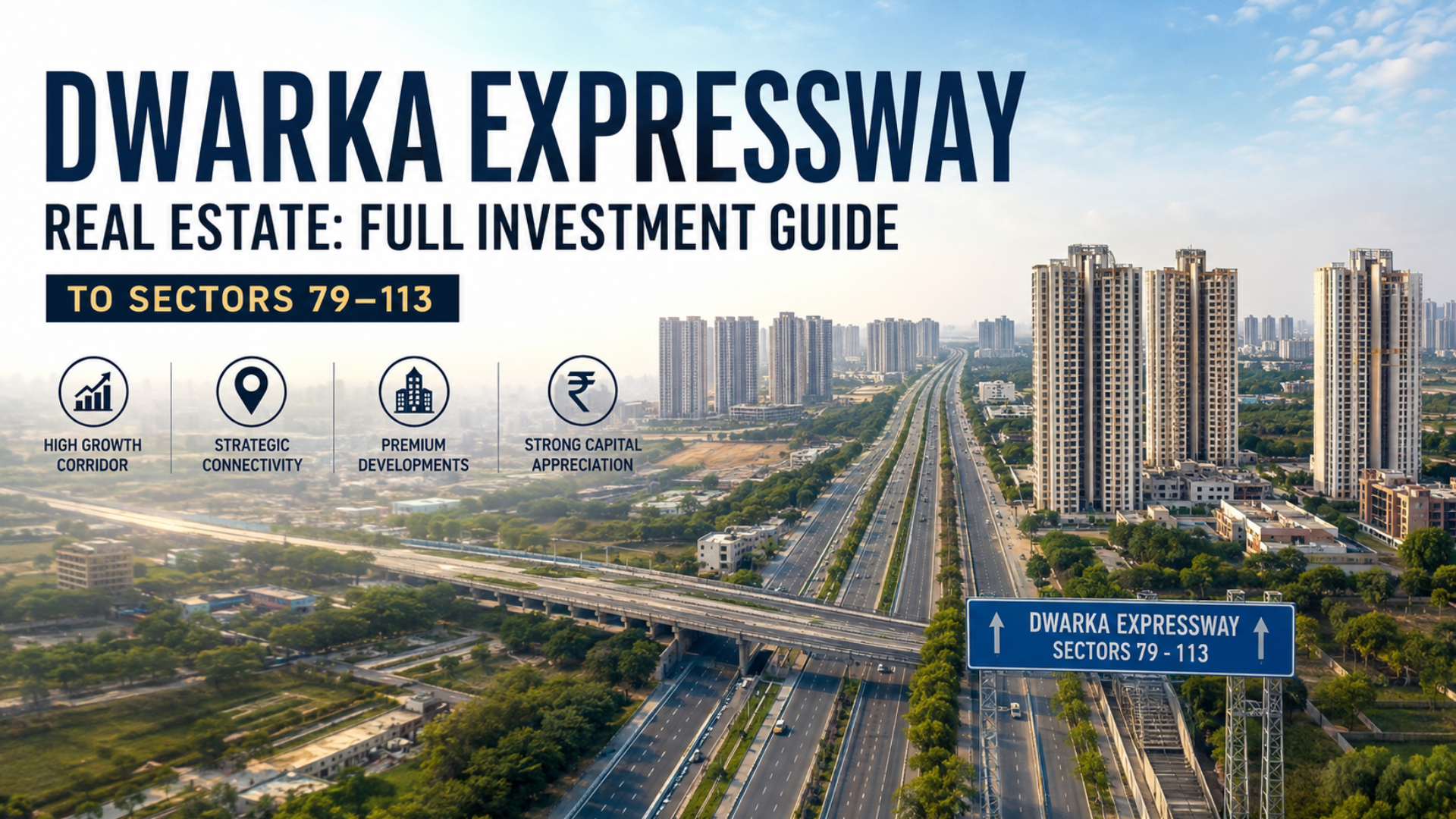
The five year numbers on Dwarka Expressway are spectacular and nearly useless. Values are up 152 percent over five years, but Sector 79 is down 1.2 percent over the last twelve months and Sector 84 is up 1.5. The corridor did not stop growing everywhere at once, it stopped in the cheap part first. This guide covers what each cluster actually asks, what the net IRR looks like after tax, why the metro date moved to December 2028, and which third of the corridor to avoid.
Written by Mansi Joshi, Marketing Intelligence Lead, ZYN33 Investment Desk. Reviewed by Ritesh Arora, Founder, ZYN33 and Strata Capital Holdings, Gurugram. Advising on Gurugram residential capital allocation since 2023, with mandates ranging from Rs 3 Cr to Rs 50 Cr. Published 30 August 2026. Last reviewed 30 August 2026.
Disclosure: ZYN33 distributes residential projects in Gurugram and is paid a transaction fee when a purchase completes, including on projects we discuss with you. We do not give tax advice. This post is general information. Take it to your chartered accountant.
The five year numbers on this corridor are spectacular and nearly useless. Asking rates are up 152.3 percent over five years on 99acres corridor data, and asking is the operative word. Over the last twelve months, Sector 79 is down 1.2 percent. Sector 84 is up 1.5 percent, Sector 91 up 1.9 percent.
Most guides bury that. A Dwarka Expressway real estate investment made in 2020 has done extraordinarily well. One made in 2025, in the fringe sectors, has done nothing. The corridor did not stop growing everywhere at once. It stopped in the cheap part first. Our position: buy 99 to 103, and 104 to 107 only at project level. Treat 79 to 95 as a market that has already paid out. Treat 108 to 113 as a road problem before it is a price problem.
Only above Rs 2 Cr, and only on a five year view. Five things need to be true before this corridor is right for your capital.
You can commit Rs 2 Cr or more without stretching leverage. You can hold five to seven years rather than two. You want capital appreciation and treat rent as secondary, because the yields here will not carry a stretched EMI. You accept construction risk and possession slippage as real, not theoretical. And you will check the HARERA filing yourself and walk the approach road before you book.
The disqualifier is liquidity. If you need to exit inside three years, transaction costs alone eat the gain. If this is not you, stop here.
There is no single number, and anyone quoting one is selling you something. Two numbers get quoted here, and confusing them is how buyers overpay.
An asking rate is what a portal or a developer price list says. A registered rate is what the sale deed at the sub registrar says. Every figure on this page is asking, quoted on super built-up area, because that is what developers and portals publish. HARERA filings carry carpet area, and the same flat produces a very different figure on each basis. A rate without a stated basis is not a rate.
On that basis, the Dwarka Expressway property price for flats runs Rs 11,000 to Rs 16,750 per sq ft on 99acres, averaging Rs 14,000. Builder floors sit lower at Rs 9,000 to Rs 13,900. Land runs Rs 17,250 to Rs 26,800.
Now watch the published averages disagree. Anarock put the corridor above Rs 9,600 per sq ft in H1 2024, reported by Business Today. PropEquity put it at Rs 17,357 for the same year. Two named research houses, one corridor, nearly double apart. Neither is lying. They measure different baskets. That spread is why you price at project level and ask the seller for comparable sale deeds, never comparable listings. A refusal to show registrations is itself information.
It depends on the sector, because the corridor is mid cycle and decelerating from the bottom up. The speculative land phase closed when the road was funded. The launch repricing phase ran 2020 to 2023. Both are behind you.
The evidence sits in the gap between long and short horizons. Sector 89 shows 179.7 percent over five years and 5.2 percent over the last one. Sector 95 shows 115.1 percent over five and 9 percent over one. Sector 79 shows 123.7 percent over five and minus 1.2 percent over one. A five year CAGR near 20 percent has become a one year print near zero in the fringe.
Supply explains it. PropEquity counted 42,816 apartments launched against 41,899 sold between 2010 and 2024. Sold units become completed units. Completed units become resale listings. Resale listings cap what the next buyer will pay.
Four things, and two of them are routinely overstated.
Connectivity is the real one. The 29 km expressway is operational end to end. The Haryana section opened in March 2024, the Delhi section on 17 August 2025, per the Press Information Bureau. A dedicated tunnel runs toward IGI Airport. Airport access is this corridor's one durable advantage over Golf Course Extension.
Metro is smaller than the marketing suggests, and less certain than it was. The Union Cabinet approved the corridor on 7 June 2023, covering 28.50 km with 27 elevated stations. It was sanctioned as HUDA City Centre to Cyber City and now runs under the name Millennium City Centre to Cyber City.
The Dwarka Expressway metro component in that 2023 sanction is a 1.85 km spur from Basai village. It was described at the time as provided for depot connectivity. Two things have changed since. The May 2026 revision sites a full depot on 22.86 hectares of government land in Sector 33, which is not where the Basai spur runs. And the 1.80 km spur named in that revision is a different one entirely. Costed at Rs 454.32 crore, it runs from Sector 5 station to Gurugram Railway Station, per The Tribune's report of the Cabinet decision.
So treat the Sector 101 station as sanctioned in 2023 and unconfirmed under the revised plan. We have not been able to source an annexure showing it survived. Until GMRL or HMRTC publishes one, it is a reason to prefer 99 to 103, not a reason on its own to buy there. Anyone selling metro access in Sector 111 is selling a different corridor that has no Union clearance at all.
Employment is close but not here. Cyber City, Udyog Vihar and the Manesar belt anchor tenant demand from commuting distance. None sit on Dwarka Expressway. Your tenant commutes.
Global City is at the other end of the road. HSIIDC places it across parts of Sectors 36, 36B, 37 and 37B, over 1,000 acres. HSIIDC awarded the Phase 1 infrastructure contract in 2023, worth around Rs 940 crore and covering roughly 570 to 587 acres. ThePrint reports around 80 percent of that physical work complete, with the remainder due by December. Full build out runs to 2035. It reshapes the Kherki Daula end and the corridor's job story. It is not a Sector 111 amenity, and it should not be sold as one.
Not one market, so not one answer. The best sectors on Dwarka Expressway depend on which trade you are making. Our sector level read on connectivity and capital growth covers the same ground from the delivery side. All rates below are asking, from 99acres sector pages, August 2026.
|
Cluster |
Asking, per sq ft |
Yield |
5 yr |
1 yr |
The read |
|
79 to 95, fringe |
Rs 7,850 to Rs 12,750 |
2 percent |
115 to 180 percent |
minus 1.2 to 9 percent |
Already paid out. Momentum gone |
|
99 to 103, central |
around Rs 13,400 |
2 to 2.5 percent |
152 percent corridor |
12 percent corridor |
The only approved metro station sits here |
|
104 to 107, premium |
Rs 16,500 to Rs 22,650 |
2.5 percent |
project specific |
project specific |
Delivered stock beside stalled stock |
|
108 to 113, luxury |
to Rs 16,750 and above |
under 2.5 percent |
project specific |
project specific |
Thinnest inventory, weakest approach roads |
Two project level anchors show why the cluster label is close to useless. Hero Homes in Sector 104 launched near Rs 5,000 per sq ft in November 2018. It now asks around Rs 16,500, over 230 percent, per Business Today. Sobha Altus in Sector 106 carries HARERA registration RC/REP/HARERA/GGM/828/560/2024/55, dated 27 May 2024. It sits on 5.51 acres, with a filed completion of April 2028 and a starting price of Rs 6.5 Cr. At its smallest configuration of 2,870 sq ft, that implies roughly Rs 22,650 per sq ft. That is 62 percent above the corridor average quoted three paragraphs ago.
Vatika Sovereign Park in Sector 99 makes the opposite point. A registration number circulates for it across listing aggregators. We are not publishing it, because we could not confirm it from Vatika's own filings or the HARERA portal. An unverified registration number is worse than none. Published possession dates for that one project range from Q4 2018 to 2027 depending on which site you read. Pull the filing yourself at haryanarera.gov.in and read the date on it. ZYN33 is a sell side distributor paid on completed transactions. Hero Homes, Sobha and Vatika are named here as market reference points. Ask us directly whether we distribute any project before you take a view from us on it. On the fringe sectors in the first row above, see our value map for flats under Rs 2 crore across Sectors 82 to 95.
Gross returns model at 3 to 10 percent depending on the sector, and the fringe sits at the bottom of that. Three real entries, modelled net of costs. Stamp duty at 7 percent for a male buyer, registration at 1 percent capped at Rs 50,000, brokerage at 1 percent. These are illustrative projections, never guaranteed returns.
|
Entry |
All in cost |
Growth |
Year 5, after exit brokerage |
Net rent a year |
Net IRR with rent |
Net IRR, price only |
|
Sector 89 fringe, 1,800 sq ft at Rs 11,050 |
Rs 2.13 Cr |
3 percent |
Rs 2.28 Cr |
Rs 3.98 L |
3.2 percent |
1.4 percent |
|
Corridor core, 1,850 sq ft at Rs 14,000 |
Rs 2.78 Cr |
7 percent |
Rs 3.60 Cr |
Rs 6.37 L |
7.4 percent |
5.3 percent |
|
Sector 104 delivered, 1,850 sq ft at Rs 16,500 |
Rs 3.27 Cr |
10 percent |
Rs 4.87 Cr |
Rs 7.63 L |
10.3 percent |
8.3 percent |
Read the last two columns together. The rent column is what separates them, and rent is the weakest part of this corridor. At 3 percent growth, roughly what the fringe delivered last year, the fringe returns 3.2 percent with rent and 1.4 percent on price alone. A fixed deposit beats both, with no illiquidity and no possession risk. If your tenant leaves for six months, the whole case for that row disappears. That is the honest downside, and it is not hypothetical.
Three rules for reading any IRR here, including ours. Compute it net, because roughly 8 percent in transaction costs takes about two years of appreciation to recover. Compute it on your drawdown schedule, since a construction linked plan spreads outflow and flatters IRR against an outright purchase. And model the base case at the developer's filed date, not the sales team's date.
Around 2 to 2.5 percent gross, which is modest and tells you what kind of corridor this is. 99acres reports average rental yield in Sector 79 and Sector 95 at 2 percent. On the core corridor, Square Yards lists one semi furnished three bedroom unit in Sector 106 at Rs 53,000 a month. Against 1,850 sq ft at the Rs 14,000 average, that single listing implies a gross Dwarka Expressway rental yield of 2.46 percent. Treat it as one listed asking rent rather than a corridor sample, and take it before maintenance, vacancy and tax.
Plan for capital growth first and rent second. Rent is a holding cost offset here, not a return. If income is the objective, this corridor is the wrong instrument and commercial stock suits you better.
Three groups, and the first is the largest. Anyone needing to sell before 2029 should stay out. The delivery wave lands first, and your buyer will have options in the same tower.
Anyone buying on a 2027 metro date should reread the timing section below, because that date no longer exists. And anyone buying the Rs 1.5 Cr to Rs 3 Cr mid segment for appreciation is buying into the thickest part of the supply curve. Surplus shows up in resale before it shows up in launch pricing. That is why the fringe printed near zero last year while the headline still read 12 percent. If unit size is your open question, our EMI arithmetic for two against three bedrooms here works it through.
Four things, and most of what gets quoted at you is not among them.
Check the last twelve month price print for your specific sector, not the corridor. That single number separates a market that has run from one that has runway. Then check registered sale deed values in the same tower, because the asking rate is the ceiling and the deed is the clearing price. Then count how many units in your sector hand over before your exit year. Then confirm whether the internal sector road is actually handed over, not planned.
What does not decide the outcome: portal averages for the whole corridor, metro connectivity claimed corridor wide, launch day absorption percentages quoted by sellers. Renderings of the road you were about to check yourself belong on that list too.
Not on the metro story, which now costs twice as much and carries no published completion date. Four Timing Triggers belong on your watchlist, and the first has already moved against the corridor.
The Haryana Cabinet revised the Gurugram Metro cost from Rs 5,452.72 crore to Rs 10,266.54 crore on 18 May 2026. It cited escalation between 2019 and 2023, revised GST rates and standalone corridor planning. A full depot with additional rolling stock, RRTS alignment changes and the new Gurugram Railway Station spur account for the rest. The 2023 sanction carried a four year build, pointing at mid 2027. That date is gone, and the Cabinet coverage of the revision does not publish a replacement. Phase 2 was still under tender evaluation by GMRL and HMRTC on 12 August 2026. Anyone buying a completed loop is buying a contract nobody has awarded.
A separate Palam Vihar to Dwarka Sector 21 corridor does propose stations at Sector 110A and Sector 111. Haryana approved its DPR in October 2022 at Rs 1,687 crore. It has never received Union clearance, and HMRTC approved revisions to that same DPR in January 2026 because the alignment had changed. A DPR reopened four years after state approval is not a timeline you can buy against.
The other three triggers are quieter and more reliable. Occupancy certificate density in your cluster, because resale liquidity changes character once a cluster crosses from majority under construction to majority occupied. Global City Phase 1 completion, targeted for the end of 2026. And internal sector road handover, the least glamorous trigger and often the largest.
Safely means a completion count before a shortlist, and a filed HARERA date before a booking. Your Entry Strategy starts with asking how many units in your sector hand over before your exit year. Thousands means you are not buying scarcity.
Cap yourself at 10 percent above ready rates for under construction stock. Buy at pre launch allocation or within 12 months of possession, never mid build, because the middle carries construction risk without the pricing advantage. Verify the registration on the HARERA Gurugram portal and read the filed completion date against the brochure date. On this corridor they often differ.
Know which payment plan you are being offered, because the plan is a risk position rather than a payment convenience. A construction linked plan ties your outflow to verified milestones and is the default safe choice. A subvention plan puts a loan in your name from day one while the developer services the interest. That transfers delivery risk to you if the developer stops paying. A possession linked plan costs more upfront in exchange for lower delivery exposure. Our risk framework for under construction against ready to move stock sets out how to price that choice.
Confirm total cost, not the headline rate. Preferential location charges, parking, club membership, IFMS and GST are quoted separately and add up. Stamp duty is charged on the higher of your transaction value or the circle rate, and the April 2026 circle rate revision raised that floor. Under construction stock attracts 5 percent GST without input tax credit, while a unit with its occupancy certificate attracts none. Choose the sector before the project, every time.
Four, and deceleration is the first because it is measurable rather than theoretical. Four fringe sectors printed between minus 1.2 percent and plus 5.2 percent over the last year while the corridor headline stayed at 12 percent. Buy the headline and you buy the wrong sector.
Oversupply is second. Launches have run marginally ahead of sales across the corridor's whole history, and those completed units now compete with you at resale. The surplus is heaviest between Rs 1.5 Cr and Rs 3 Cr, thinnest above Rs 5 Cr. That is why prime sectors have absorbed better.
Last mile roads are third. Internal access in parts of Sectors 108 to 113 remains incomplete, which caps achievable rent whatever the expressway does. Walk the approach road before you commit, once in daylight and once after rain. That hour outranks any brochure.
Transaction cost is fourth and the most commonly ignored. Roughly 8 percent in, plus brokerage out, means anything under a five year hold starts underwater.
On a price trigger, an event trigger or a time cap, whichever fires first. Decide all three before you enter, and write them down.
Price based: our house rule is to book out around 60 to 70 percent gross appreciation. That is a ZYN33 discipline for taking profit off the table, not a forecast and not a historical average. Set it on the net number, since 60 percent gross lands nearer 45 percent after entry duty, exit brokerage and capital gains tax.
Event based: sell in the twelve months after the Sector 101 station opens, and only if you own in 99 to 102. Time based: avoid selling into 2027 and 2028, when the delivery wave puts thousands of comparable doors beside yours. If you reach year seven and neither trigger has fired, sell anyway. A thesis that has not paid in seven years on a mid cycle corridor is not slow. It is wrong.
One table to land on after four clusters, three scenarios and two metro corridors.
|
Cluster |
Verdict |
Entry, asking |
Hold |
What to watch |
|
79 to 95 |
Avoid for appreciation |
Rs 7,850 to Rs 12,750 |
n/a |
Twelve month print, not the five year one |
|
99 to 103 |
Buy |
around Rs 13,400 |
5 to 7 years |
Whether the Sector 101 station survives the revised DPR |
|
104 to 107 |
Buy at project level only |
Rs 16,500 to Rs 22,650 |
5 to 7 years |
The filed HARERA completion date |
|
108 to 113 |
Wait |
to Rs 16,750 and above |
7 years plus |
Internal road handover in your sector |
In two of the four clusters, yes. Dwarka Expressway real estate investment works in 99 to 103, where the only approved metro station sits. It also works at project level in 104 to 107, once you have read the filed completion date. Buy nothing in 79 to 95 for appreciation, because that trade is finished and the last twelve months prove it.
If you need liquidity inside three years, this corridor is the wrong instrument. That is a disqualification, not a warning. If the delivery wave is what puts you off, SPR carries a different supply profile.
Holding Rs 2 Cr or more with a decision due in 60 to 90 days? Send your budget, target sector and holding window. We return a sector level read with that sector's completion count and the registered comparables behind the asking rates on this page.
Strata Capital Holdings tracks registered pricing, entry points and corridor value across Gurugram as it moves. ZYN33 brings that intelligence to every capital allocation conversation. That is why this note names the third of the corridor you should avoid as clearly as the parts you should not.
99acres, Dwarka Expressway corridor asking rates and appreciation, August 2026
Business Today, Anarock corridor data and Hero Homes Sector 104 benchmark, 24 August 2026
BW Businessworld, PropEquity launch and absorption data 2010 to 2024
ThePrint, Global City Phase 1 contract award and construction progress, August 2026
Metro Rail News, Phase 2 tenders under GMRL and HMRTC evaluation, 12 August 2026
HARERA Gurugram portal, project registrations and filed possession dates
Disclaimer
This article is general information about tax and property mechanics in India. It is not tax advice, investment advice or a recommendation to buy a specific property, and it does not account for your personal circumstances. Rates, thresholds and deadlines change. Verify every figure against the source listed above and take your liquidation plan to a qualified chartered accountant before you sell anything. ZYN33 distributes residential projects in Gurugram and is paid a transaction fee when a purchase completes. We do not act as your tax adviser or your adviser on the equity side.
Tell us your budget and timeline.
Tell us your budget and timeline.