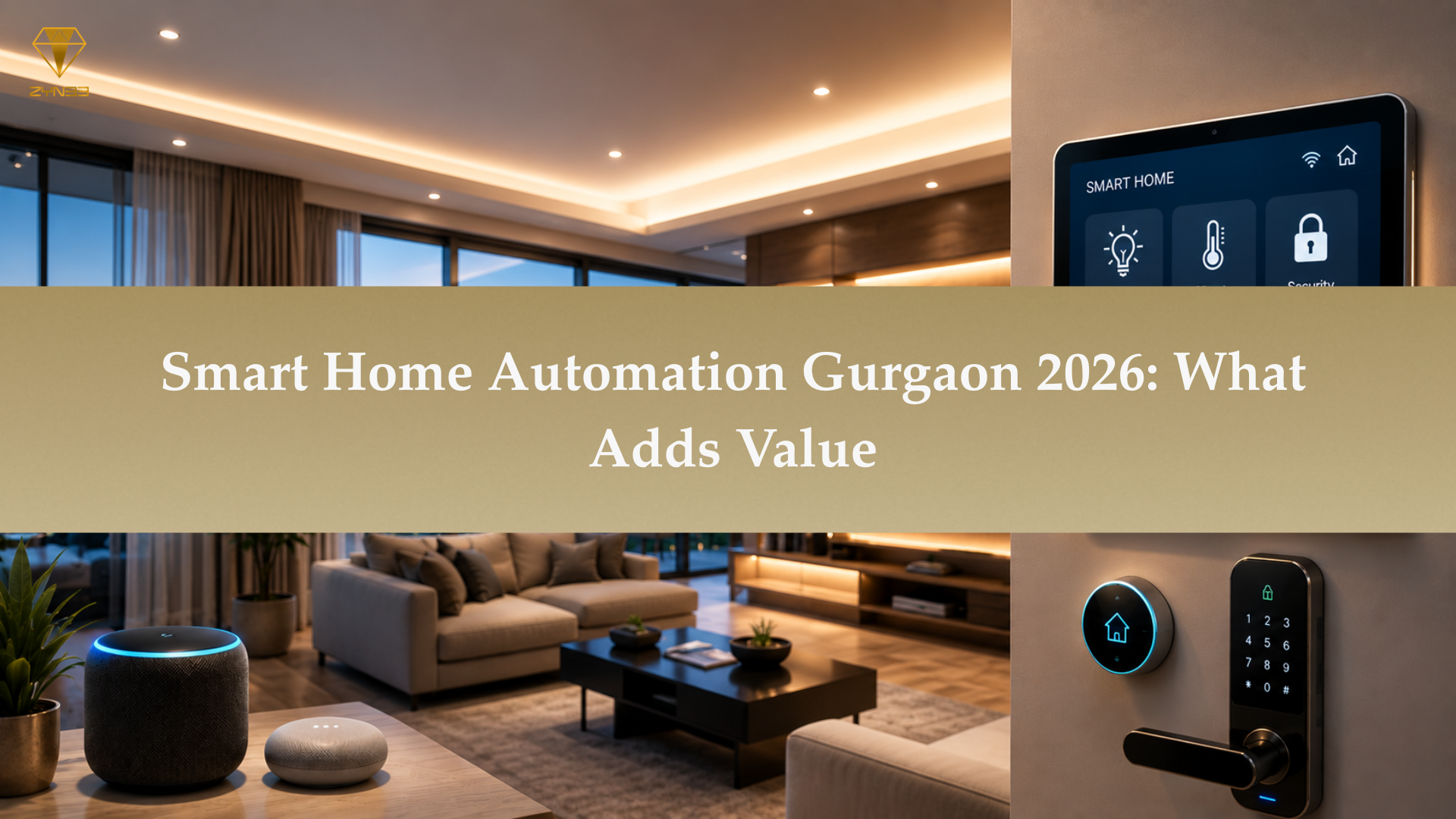
The spend is knowable and the payback is not. Installer pricing for a wired 3 BHK runs Rs 2.50 to Rs 4.50 lakh, and a luxury villa Rs 6 to Rs 15 lakh or above. Figures near Rs 60,000 price the plug in tier of sensors and switches, which is the gadget sprawl the market tells you to avoid. No independent Indian study publishes a resale premium for automated homes, and every source offering one sells systems. Buy climate, security and load management to live with them, and treat any exit benefit as upside.
Written by Mansi Joshi, Marketing Intelligence Lead, ZYN33 Investment Desk. Reviewed by Ritesh Arora, Founder, ZYN33 and Strata Capital Holdings, Gurugram. Advising on Gurugram residential capital allocation since 2023, with mandates ranging from Rs 3 Cr to Rs 50 Cr. Published 30 May 2026. Last reviewed 30 September 2026.
Disclosure: ZYN33 distributes residential projects in Gurugram and is paid a transaction fee when a purchase completes, including on projects we discuss with you. We do not give tax advice. This post is general information. Take it to your chartered accountant.
The spend is knowable. The payback is not. That gap is the whole decision.
Buyers judge smart home automation Gurgaon by feature count. Ask instead what the systems cost to wire, and whether any local resale comparable paid for them. Installer pricing is documented. Resale evidence is not. So buy integration to live with it, and treat any exit benefit as upside.
|
Your situation |
What to do |
|
New stock above Rs 5 Cr |
Demand wired, builder fitted systems. Price the gap between brochure and quote |
|
Premium resale, Rs 2 to Rs 5 Cr |
Budget Rs 2.50 to Rs 4.50 lakh, not Rs 60,000 |
|
Under Rs 1.5 Cr for yield |
Skip it. No rent premium covers a six figure fit out |
|
Sold by a gadget demo |
Pay nothing for it. Loose devices carry no resale weight |
If none of those is you, stop here.
Around half what the circulating figure claims. Mordor Intelligence, updated 21 January 2026, sizes the Indian market at USD 6.71 billion this year, up from USD 5.20 billion in 2025.
Next Move Strategy Consulting disagrees on level. Published 2 April 2026, it puts 2025 at USD 4.49 billion and 2030 at USD 16.39 billion. Two houses, adjacent years, a base gap of USD 0.71 billion. Report the divergence rather than the flattering number.
Both agree on growth, close to 29 percent a year. That matters more than the level. It tells you today's premium feature is next year's fitting.
Apply cycle positioning to the technology, not the corridor.
Voice controlled lighting set a home apart in 2020. By 2026 it is a fitting, like a geyser. At 29 percent growth, nothing on show today stays distinctive for long. The premium has moved to what is hard to retrofit: climate networks reading outdoor air, whole home load management, and multi user access control. Pay for what cannot be added later.
Climate and air. Cost: no installer publishes a standalone figure, so it sits inside the whole home bands below. Durability: strongest of the four. Verdict: buy. On 28 September 2026 IQAir read Gurugram at AQI 147, PM2.5 54.2 micrograms per cubic metre. That is a spot reading, not an annual mean, and 10.8 times the World Health Organization annual guideline.
Security and access. Cost: locks at Rs 6,000 to Rs 20,000 each, plus cameras. Durability: high for this buyer. Verdict: buy, wired rather than app per device. The Camellias and M3M Heights in Sector 65 are both positioned as premium stock. Neither publishes a resale figure traceable to automation.
Energy and load. Cost sits inside the villa bands below. Durability: moderate. Verdict: buy the load management, not the solar story. PM Surya Ghar pays Rs 30,000 at 1 kW, Rs 60,000 at 2 kW, then Rs 78,000 from 3 kW, capped. Haryana adds nothing. On a villa load that is a rounding error.
Standalone gadgets. Cost: Quick Sense prices a whole plug in 1 or 2 BHK at Rs 8,000 to Rs 50,000. Durability: none. Verdict: skip. Speakers, novelty mirrors and an app per device photograph well and get removed.
Three installers, and the spread reveals the scope. Fox Domotics, 16 July 2026, prices a 3 BHK at Rs 2.50 to Rs 4.50 lakh. A luxury villa runs Rs 6 to Rs 15 lakh or above. Brightmatic prices lighting and curtains alone at Rs 4 to Rs 8 lakh. A full KNX villa runs Rs 15 to Rs 30 lakh or above. Quick Sense Innovations prices a 3 BHK at Rs 50,000 to Rs 1.50 lakh.
That last band is not a cheaper version. It is a different product: sensors, switches, plugs, a lock. So any home automation cost in India quoted near Rs 60,000 for a whole flat is pricing plug in devices. Judge a quote by its wired point count.
All three are illustrative, not guaranteed.
Case A, the integrated villa. A Rs 5 Cr villa wired at the verified Rs 6 to Rs 15 lakh band. That is 1.2 to 3.0 percent of value, not the 1 percent usually quoted. Over 5 to 7 years the running saving is real. The resale effect is unproven.
Case B, the honest retrofit. A 3 BHK at Rs 2.50 to Rs 4.50 lakh for climate, wired lighting and access. On a Rs 3 Cr flat that is 0.8 to 1.5 percent. Sensible if you live there.
Case C, the premium trap. A Rs 15 to Rs 20 lakh premium for a home sold on technology that turns out to be unconnected devices. That is 3 to 4 percent of a Rs 5 Cr ticket. Most of it does not survive, because smart home resale value attaches to wiring rather than device count.
|
Profile |
Budget |
Hold |
Action |
|
Ultra luxury end user |
Rs 5 Cr plus |
5 to 7 years |
Wired and builder fitted. Price it at Rs 6 to Rs 15 lakh |
|
Premium resale upgrader |
Rs 2 to Rs 5 Cr |
4 to 6 years |
Climate, security, load only. Budget Rs 2.50 to Rs 4.50 lakh |
|
Yield investor |
Under Rs 1.5 Cr |
Any |
A lock and a meter. Nothing more |
Three buyers, and none is timid. Anyone under Rs 1.5 Cr buying for rent: the yield cannot fund the fit out. Anyone holding under three years: you pay the capital and collect none of the saving. Anyone refused a written point count is being shown a demonstration, which is worth nothing. Device count is not what defines a true luxury apartment in Gurgaon.
|
What matters |
What is noise |
|
Wired point count and written protocol |
The number of connected devices |
|
Climate response tuned to local AQI |
Novelty mirrors and speakers |
|
Who services it in year five, named |
The installer's showroom |
|
Load management across the whole board |
Voice control as the headline |
|
A resale comparable you can inspect |
A premium quoted by the vendor |
Four triggers, and only one is technical. Builders on Golf Course Extension Road moving wired systems into base plans, which shifts the cost to the sticker. A published Indian resale study, which does not exist and would change the conclusion overnight. Matter builds converging enough that servicing risk genuinely falls. And the Rs 10 crore line hardening, since above it technology is assumed.
Ask for four documents, not a walkthrough. The protocol with its specification version, Matter being the standard under the Connectivity Standards Alliance. The wired point count, room by room. A service contract naming an entity and a term. The HARERA registration and the developer's delivery record. An integrated home in a late tower is still late.
Three risks, and the first surprises people. The Matter protocol does not remove servicing risk by itself. Its own status reporting documents gaps between the Amazon, Apple and Google builds. Identical hardware behaves differently across them. Compliance narrows your exposure without closing it.
Second, reinforced concrete in Gurugram towers blocks wireless signal, so a radio led setup underperforms from handover. That is why the wired count matters.
Third, overcapitalisation. A Rs 4 lakh fit out in a Rs 1.2 Cr flat is 3.3 percent of value. The same spend in a Rs 5 Cr villa is under 1 percent. The spend is not wrong. The pairing is.
On price, sell once an unautomated comparable trades close enough that your premium shows in the spread. No comparable means no premium, only a preference. On event, sell when your generation becomes the baseline. On time, exit inside the 5 to 7 year generation window. That is the same logic as what green certification is actually worth.
Buy the three systems that solve a Gurugram problem, at their real price, in an asset that carries them. Climate first, because the AQI number is real. Security second. Load third.
Then treat the spend as consumption. What installers charge for smart home automation Gurgaon is documented. The resale premium is not, by anyone without a system to sell. Whoever tells you the fit out pays for itself at exit wants you to fund their showroom.
Strata Capital Holdings tracks price bands, specification and inventory across Gurugram's corridors. ZYN33 brings that into the room when capital is placed.
Mordor Intelligence, India Smart Home Market, 21 January 2026.
Next Move Strategy Consulting, 2 April 2026.
Fox Domotics pricing, 16 July 2026.
Brightmatic scope pricing, 2026.
Quick Sense Innovations, 2026.
IQAir Gurugram, retrieved 28 September 2026.
Matter standard status review, 3 January 2026.
PM Surya Ghar subsidy structure, August 2026.
M3M Heights, Sector 65, confirming the project exists.
No independent Indian study publishing a smart home resale premium could be located. Every source offering one sells systems or installation.
Penthouse interior design: Gurgaon trends
Ready to move against under construction
Sector 48 for mid segment investment
Luxury apartments in Gurgaon: the investor's guide
4 BHK luxury apartments: the shortlist
Luxury apartments with pool: the verdict
Disclaimer
This article is general information about tax and property mechanics in India. It is not tax advice, investment advice or a recommendation to buy a specific property, and it does not account for your personal circumstances. Rates, thresholds and deadlines change. Verify every figure against the source listed above and take your liquidation plan to a qualified chartered accountant before you sell anything. ZYN33 distributes residential projects in Gurugram and is paid a transaction fee when a purchase completes. We do not act as your tax adviser or your adviser on the equity side.
Tell us your budget and timeline.
Tell us your budget and timeline.