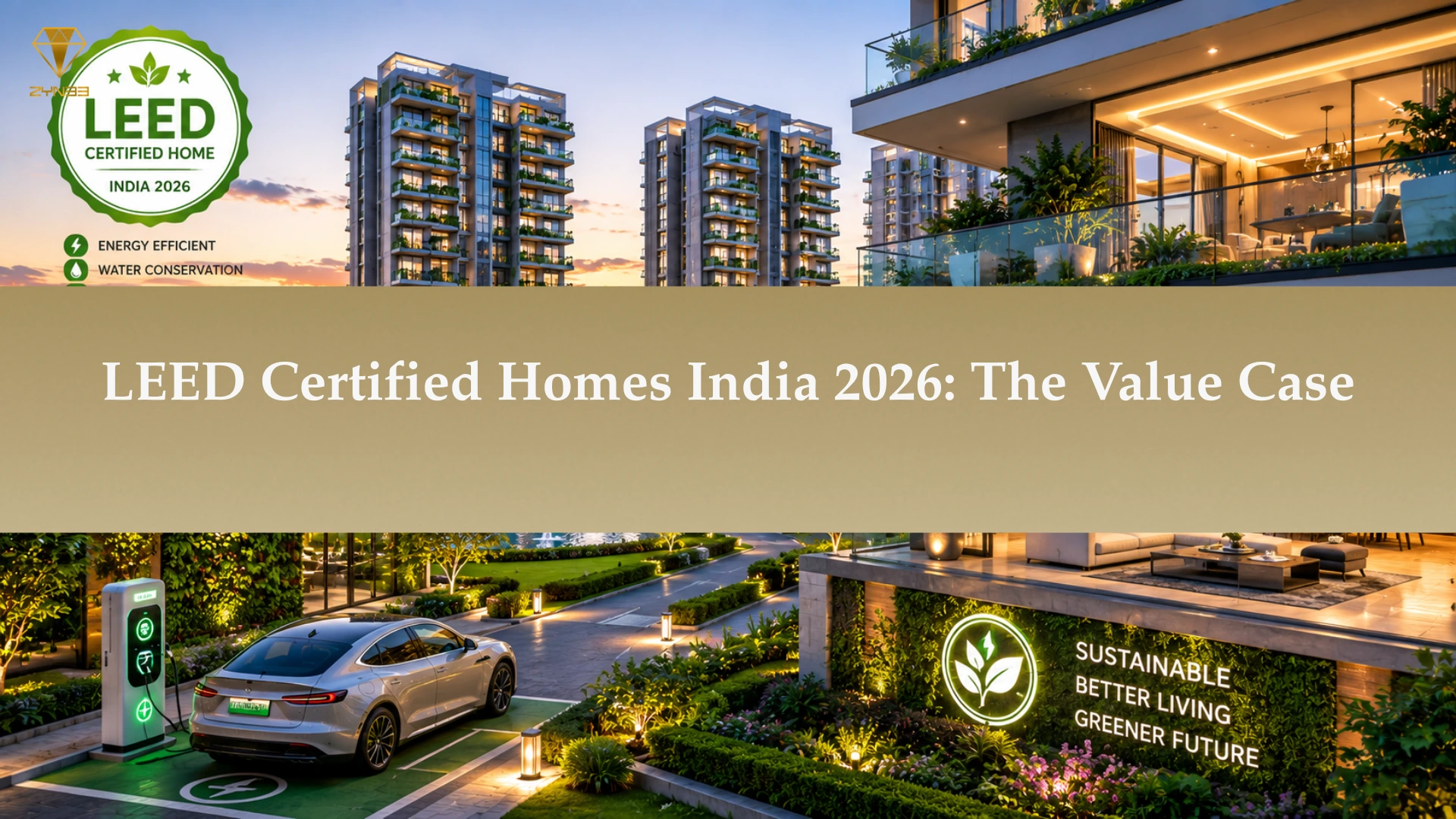
Green certification is sold as free upside: pay a premium, collect a bigger one at resale. It is not. LEED adds 10 to 15 percent to build cost and resells at 10 to 12, so the badge alone can lose money. IGBC is the better arithmetic. And the Haryana FAR incentive that developers cite may not cover residential at all. Here is the value case with both sides of the ledger.
Written by Mansi Joshi, Marketing Intelligence Lead, ZYN33 Investment Desk. Reviewed by Ritesh Arora, Founder, ZYN33 and Strata Capital Holdings, Gurugram. Advising on Gurugram residential capital allocation since 2023, with mandates ranging from Rs 3 Cr to Rs 50 Cr. Published 4 June 2026. Last reviewed 28 September 2026.
Disclosure: ZYN33 distributes residential projects in Gurugram and is paid a transaction fee when a purchase completes, including on projects we discuss with you. We do not give tax advice. This post is general information. Take it to your chartered accountant.
A LEED rating adds 10 to 15 percent to what a tower costs to build. It adds 10 to 12 percent to what the flat resells for.
Those two numbers are almost never printed together. Side by side, the badge is close to break-even on resale. The case for it has to be made elsewhere.
Less than the headline, once the build cost is netted off.
|
System |
Adds to build cost |
Adds at resale |
Net on the badge alone |
|
IGBC certification |
3 to 5 percent |
5 to 8 percent |
0 to plus 5 |
|
GRIHA |
2 to 4 percent |
3 to 5 percent |
minus 1 to plus 3 |
|
LEED |
10 to 15 percent |
10 to 12 percent |
minus 5 to plus 2 |
Read the right-hand column before the middle one. On resale alone, IGBC is the only system that cannot lose, and LEED is the one most likely to.
That inverts the usual advice. LEED carries the strongest brand and the weakest resale arithmetic. What makes it credible abroad is what makes it expensive to build.
From the top of one system's range, applied to all three.
The green home premium is quoted as 10 to 20 percent across Indian cities. By system it is LEED 10 to 12, IGBC 5 to 8, GRIHA 3 to 5.
So the band's floor is the ceiling for two of the three systems. And the system most Gurgaon luxury stock carries, IGBC, sits second from bottom.
This is where certification pays, and it is the part usually treated as a footnote.
Certified homes are reported to use materially less energy and water. The savings run roughly 15 to 25 percent on energy for IGBC, 20 to 30 for GRIHA and 25 to 40 for LEED.
Unlike the resale premium, that arrives every year you hold. Over ten years it compounds past what the badge premium reaches.
Note what that does to the holding period. A short hold pays the build cost and collects almost none of the saving. Certification is a long-hold case, which is the opposite of how it is sold.
Possibly not, and this is worth checking before you accept the developer's reasoning.
The argument runs that developers favour IGBC because states grant extra floor area for it. Haryana does offer that: 9 percent at Silver, 12 at Gold, 15 at Platinum. It sits in the Haryana Building Code 2017, amended 8 May 2018.
But reporting of that same order describes the incentive as available to commercial and industrial property. IGBC's own listing does not state a category restriction either way.
The two accounts disagree, and we report both rather than picking. If a seller explains the green premium by pointing at FAR, ask which notification covers residential buildings in your category, and read it.
A claim circulates that certified stock appreciates at 12 to 15 percent a year against 9 to 11 for comparable non-certified luxury.
Test the floor of that against the corridors. Golf Course Road printed plus 6.5 percent over twelve months. Golf Course Extension printed minus 0.8.
The claimed rate for non-certified stock sits above what the city's strongest corridor did. A three point certified advantage may exist. It has not been shown, and should not be modelled as though it has.
Larger than most coverage says, and growing fast enough that quoted figures go stale within months.
IGBC's own site, dated 1 September 2026, gives 20,164 registered projects across 16.42 billion square feet, with 8,350 certified and fully operational.
Figures of 19,000 projects and 15.74 billion square feet are still widely repeated. They were current once. On a fast-moving count, take the number from the council rather than an article about it.
DLF confirms LEED Platinum for The Camellias on its own site, alongside a 2021 press reference calling it the first in India so accredited.
What DLF does not publish is a saving percentage. A widely quoted figure of over 32 percent energy against ASHRAE benchmarks could not be traced to the developer or to the certifying body.
The certification is verifiable and the tier is the highest available. The performance number attached to it in coverage is not. Do not underwrite on it.
|
What matters |
What is noise |
|
The certificate number and its tier |
The word green anywhere in the brochure |
|
Whether it was awarded on design or on the built asset |
Solar panels added to a conventional tower |
|
Which notification covers your building category |
A FAR incentive cited without its scope |
|
Measured consumption after occupancy |
A modelled saving from the design stage |
Three.
Anyone holding under five years. You pay the build cost premium on entry and leave before the running-cost saving has compounded into anything.
Anyone shown a rating without a certificate. A design-stage rating never verified on the finished building is a plan, not an attribute.
Anyone paying a LEED premium into a domestic resale market. That brand is worth most to a buyer who has lived with it abroad.
Three things. Building code revisions under India's net-zero commitment, raising the floor every certified building already clears. FAR incentives if states extend them to residential. And a deeper resale pool, which turns a premium from anecdote into a comparable.
None of these is a price forecast. Certified supply is growing faster than certified demand is being measured.
Four steps, before any premium is agreed.
Ask for the certificate, not the rating, and read the tier on it. LEED runs Certified, Silver, Gold and Platinum, with Platinum from 80 points. IGBC uses the same four names. GRIHA scores 1 to 5 stars over 100 points.
Then confirm it was issued against the completed building rather than the design. Ask for consumption data from occupied units, because a certificate records intent and a meter records performance.
Finally, price it. Take the system's resale premium, subtract the build cost premium, and treat the remainder as what the badge is worth before running costs.
Design-stage certification is the first risk. A rating earned on a model and never confirmed on the built asset tells you what was intended, not what was delivered.
Maintenance is the second. Certified systems need servicing, and an association that underfunds it loses the saving while keeping the plaque.
Thin comparables are the third. The premium only exists where a local resale market can show it, and in most corridors there are too few certified resales to price one.
Evidence based: sell once certified resales in your micro-market are frequent enough to set a comparable. A premium no valuer can point at is not a premium.
Regulation based: as codes tighten, non-certified stock starts to discount rather than certified stock rising, and that is the window worth selling into.
Horizon based: below five years the arithmetic fails. A certified home is a long hold, or just a dearer flat.
For IGBC stock on a long hold, yes. It costs 3 to 5 percent more to build and returns 5 to 8 at resale. It also pays 15 to 25 percent off the energy bill every year.
For LEED, buy the building rather than the badge. It is close to break-even on resale. The case rests on running costs, and on a buyer who values the international standard. Pay for a verified certificate, never for the word.
Strata Capital Holdings tracks price bands, specification and inventory across Gurugram's corridors. ZYN33 brings that into the room when capital is placed. We distribute residential projects and are paid a transaction fee on completion, including on anything we discuss.
DLF, The Camellias: LEED Platinum confirmed on the developer's own site, with a press reference of 28 February 2021 calling it the first in India so accredited. No energy saving percentage is published
Net-of-cost figures are ZYN33 calculation: each system's resale premium less its build cost premium. Current published ranges, not forecasts. A claim that certified stock appreciates at 12 to 15 percent against 9 to 11 could not be traced and is not adopted
Disclaimer
This article is general information about tax and property mechanics in India. It is not tax advice, investment advice or a recommendation to buy a specific property, and it does not account for your personal circumstances. Rates, thresholds and deadlines change. Verify every figure against the source listed above and take your liquidation plan to a qualified chartered accountant before you sell anything. ZYN33 distributes residential projects in Gurugram and is paid a transaction fee when a purchase completes. We do not act as your tax adviser or your adviser on the equity side.
Tell us your budget and timeline.
Tell us your budget and timeline.