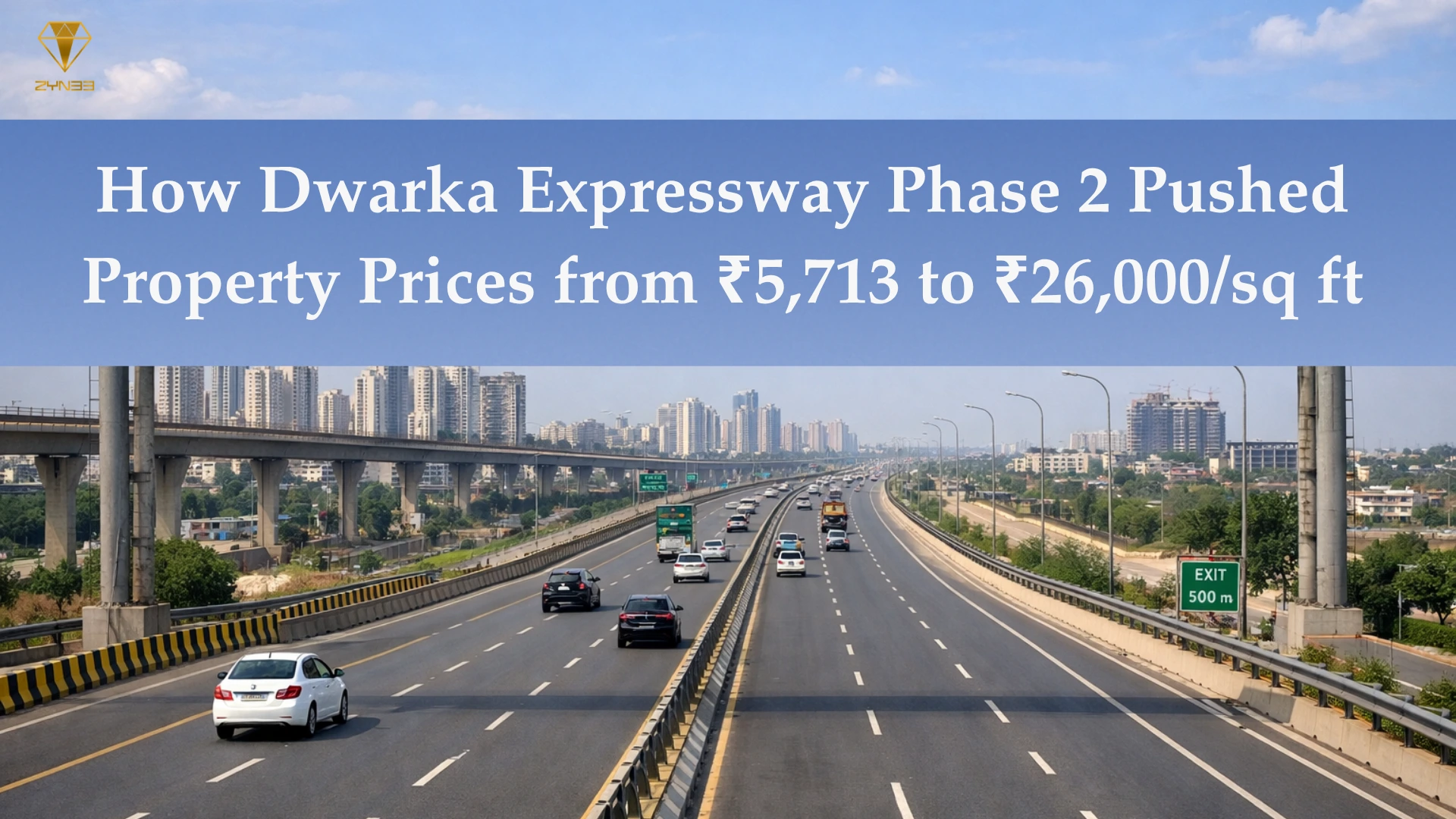
The Dwarka Expressway Phase 2 has fundamentally redrawn the real estate map of Delhi-NCR. Since the completion of the 10.1-kilometre Delhi section, property prices along the corridor have surged from Rs 5,713 per square foot in 2018 to over Rs 21,000 in 2026, with a staggering 58% year-on-year spike recorded between Q4 2024 and Q1 2025, the steepest appreciation of any residential corridor in India during that period. This guide covers everything a buyer or investor needs to know: year-by-year price trends backed by Anarock and PropEquity data, sector-wise breakdowns across Sectors 103, 104, 106, 111, and 113, a developer comparison table, the Yashobhoomi IICC effect on Delhi-side real estate, the 2026 circle rate revision impact, and upcoming infrastructure triggers including the Delhi Metro Blue Line extension and Global City project. Whether you are buying to live or investing for the long term, this is the most complete picture of the Dwarka Expressway market available today.
Written by Mansi Joshi, Marketing Intelligence Lead, ZYN33 Investment Desk. Reviewed by Ritesh Arora, Founder, ZYN33 and Strata Capital Holdings, Gurugram. Advising on Gurugram residential capital allocation since 2023, with mandates ranging from Rs 3 Cr to Rs 50 Cr. Published 2 April 2026. Last reviewed 8 September 2026.
Disclosure: ZYN33 distributes residential projects in Gurugram and is paid a transaction fee when a purchase completes, including on projects we discuss with you. We do not give tax advice. This post is general information. Take it to your chartered accountant.
Asking rates on this corridor went from about Rs 5,713 to roughly Rs 14,000 per sq ft. That is 145 percent over eight years, or about 11.9 percent compound.
That is on flats, and the asset class matters more than the percentage. 99acres puts corridor flats at Rs 11,000 to Rs 16,750 and land at Rs 17,250 to Rs 26,800 on the same page.
So a headline running from Rs 5,713 to Rs 26,000 is not wrong about either end. It compares an early flat rate with a current land rate. Or with new launch pricing, which trade coverage puts at Rs 20,000 to Rs 25,000. Those are different things, and the move looks larger than the flat market delivered.
The Haryana one. The expressway opened in two stages nearly eighteen months apart, and attributing the repricing to the wrong stage inverts the causality.
|
Stage |
Date |
Scope |
|
Haryana section |
11 March 2024 |
19 km, built at about Rs 4,100 crore, in two packages of 10.2 km and 8.7 km |
|
Delhi section |
August 2025 |
10.1 km including the airport tunnel connection |
So a surge dated to late 2024 or early 2025 follows the March 2024 Haryana opening. It cannot have been caused by a Delhi section that had not opened yet. That distinction matters for anyone modelling forward. The Haryana repricing has been running for over two years, while the Delhi effect is barely a year old.
One divergence to note. Some sources date full operational status to June 2025 rather than August. We are using August, but the point stands either way.
From Rs 9,000 to Rs 26,800 depending on what you are buying. Dwarka Expressway property prices only make sense once you separate flats from land from builder floors.
|
Measure |
Figure |
|
Flats, asking |
Rs 11,000 to Rs 16,750, average Rs 14,000 |
|
Land, asking |
Rs 17,250 to Rs 26,800 |
|
Builder floors, asking |
Rs 9,000 to Rs 13,900 |
|
New launch and under construction, reported |
Rs 20,000 to Rs 25,000 |
|
Listed properties |
7,621 |
|
Sector 106 |
about Rs 15,800 |
|
Last 12 months, corridor |
plus 12.0 percent |
|
Last 12 months, Sector 95 |
plus 9 percent |
|
Last 12 months, fringe sectors |
minus 1.2 percent |
|
Last 3 years |
plus 75 percent |
|
Last 5 years |
plus 152.3 percent |
|
Portal reported gross yield |
about 2 percent |
Look at the land row before anything else. At Rs 26,800 it is nearly double the flat average, so a corridor figure quoted without an asset class is close to meaningless. That is where most headline numbers for this corridor come from.
Read the fringe row against the corridor row too. Dwarka Expressway sector rates now span from negative to double digit growth inside one stretch. The sector wise price comparison breaks that down cluster by cluster.
Published figures give three different lengths, and they reconcile into one answer rather than contradicting each other.
Sources variously describe the IGI airport tunnel as 3.5 km, 3.6 km and 5.1 km. The most likely reading is that 5.1 km is the total tunnel connection. Roughly 3.6 km is the main tunnel beneath the airport, with a link section making up the balance. Note that 3.6 plus 1.5 equals 5.1.
Two further inconsistencies worth knowing. The tunnel is described as both deep and shallow across sources. And its cost is reported at about Rs 1,000 crore in secondary coverage, which we have not been able to trace to an NHAI figure. Total project cost is published at Rs 8,662 crore, about Rs 9,000 crore and about Rs 10,000 crore depending on the source.
None of that changes the investment case. It does mean any post quoting a single precise tunnel specification is quoting one source and ignoring the others.
No. A metro along Dwarka Expressway has been planned by DMRC but remains pending approval from the Haryana government.
Separately, the Union Cabinet approved the Millennium City Centre to Cyber City corridor in June 2023. It runs 28.5 km across 27 stations. A 1.85 km spur to the Basai depot touches this corridor at Sector 101, and that is its approved station. The Haryana Cabinet revised the project cost to Rs 10,266.54 crore on 18 May 2026 without publishing a replacement completion date.
So there is no confirmed metro for 2026 to 2027 here. Price the Sector 101 station you can name, and treat anything else as proposed.
Post delivery, decelerating from the outside in. That is a specific stage and it changes what you should expect.
The infrastructure that drove the repricing is finished. Both sections are open, the airport connection exists, and there is no further road catalyst pending. What remains is absorption of the supply launched against the promise, which Gurgaon property price trends sets in citywide context.
The evidence for deceleration is in the sector spread. Fringe sectors printed minus 1.2 percent over twelve months while the corridor averaged plus 12. The five year figure of plus 152.3 percent describes repricing that has already happened. Using it forward is the most common error made on this corridor.
Yes in an inner sector still printing positive, on a five year view, and not on the corridor's historical figure. Four situations sort it.
Buying to occupy with delivered connectivity to Delhi and the airport? This corridor now offers that, and the premium for it is already priced. Buying for growth? Pick a sector, not the corridor, since the spread runs from minus 1.2 to plus 12 percent.
Buying for rental income? At about 2 percent gross this does not solve that. Buying on the 152.3 percent five year number? That describes the past. If this is not you, stop here.
Less than the draft proposals suggested, and about half the district saw nothing at all.
Draft rates circulated in early 2026 proposing increases of up to 67 percent for this corridor under the collector rate revision. Those were superseded. The final rates took effect on 1 April 2026, and per the Deputy Commissioner's statement the average increase across the district was 15 to 30 percent, with about 51 percent unchanged and around 11 percent rising by as much as 75.
Any post quoting the draft figures is quoting a proposal, not the notification. Pull the tehsil document covering your sector from the District Gurugram site, since duty applies to the higher of your price or the collector rate.
Because every figure in this post, and in every competing post, is an asking rate. None is a sale price.
Portal series record what sellers list at. Registered rates record what buyers paid, and they are not published at sector level in Haryana. The gap between the two is real and it is not measurable from public data.
What follows practically. Treat registered against asking rates as your negotiation frame. The corridor average is a ceiling on what sellers hope for, not a floor on what units trade at. Ask for the last three registered transactions in the specific project. Use the tehsil collector rate as the only published number reflecting an official valuation.
With a written ceiling per sector, not per corridor, and on carpet rather than super area.
Take the corridor flat average of about Rs 14,000 as your reference, and make sure you are comparing like with like. In a fringe sector printing negative, that average is already generous and your ceiling should sit below it. In an inner sector printing double digits, a premium is defensible up to the point where you can name the comparable that justifies it.
Then convert to carpet. HARERA Gurugram registers carpet area and brochures quote super built up, with a gap typically running 35 to 45 percent. A rate that looks reasonable on super can be well above the market on carpet. That is the basis a resale buyer will use against you.
Anyone buying the corridor rather than a sector. A 13 point spread between the fringe and the average means the corridor number tells you very little about your asset.
Anyone buying for rental income at about 2 percent gross, before maintenance, vacancy and slab tax. Anyone pricing in a metro that remains pending Haryana approval. Anyone using the 152.3 percent five year figure as a forward expectation. And anyone with an exit horizon under four years, given roughly 8 percent in entry costs.
Six things, and the first two are where corridor posts mislead most.
Get the twelve month print for your specific sector rather than the corridor, since the two now diverge by more than thirteen points. Then get the carpet area from the HARERA Gurugram filing and recompute the quoted rate on it.
Third, verify the registration number and filed possession date at haryanarera.gov.in. Gurugram and Panchkula are separate benches, and sites such as hrera.in and hrera.org.in are not the authority. Fourth, check the collector rate for the sector. Fifth, ask for the last three registered transactions in the project. Sixth, drive the route to the airport at your actual travel hour. Published figures for that journey vary widely, so do not accept a quoted drive time.
Catalyst exhaustion is the first Risk and it is structural. The road was the story, the road is built, and there is no second road coming.
Supply absorption is second. Sectors launched heavily against the expressway promise, so your resale competes with completions landing in the same window as well as with other owners.
Third, sector divergence, already visible at minus 1.2 against plus 12 percent. Fourth, yield, which offers no floor at about 2 percent. Fifth, data quality. No registered series exists for this corridor and every published figure is an asking rate. The same page carries three bands differing by nearly three times depending on asset class.
Price based: measure against registered comparables in your own project, not the corridor average. Then net out duty already paid, exit costs and capital gains.
Event based: there is no pending road trigger here, which is the point. The remaining triggers are local, meaning social infrastructure completing inside your sector and competing supply clearing.
Time based: five to seven years in an inner sector, longer on the fringe. Below four years, entry and exit costs alone put you behind a corridor whose outer sectors are already flat.
Yes, and it is behind you rather than ahead of you. On flats, Rs 5,713 to about Rs 14,000 is 145 percent at roughly 11.9 percent compound. On land the top of the band reaches Rs 26,800, which is where the bigger headline numbers come from.
What the numbers do not support is a repeat. The road that caused it is finished and the fringe has already stopped. Dwarka Expressway property prices now diverge by more than thirteen points inside one corridor. Buy the sector on its own print, price on carpet, and treat the corridor's historical figure as history.
Considering Rs 1 Cr to Rs 10 Cr on this corridor with a decision due in 60 to 90 days? Send your target sectors. We return the twelve month print for each one rather than the corridor. The carpet area, filed possession date and collector rate floor come with it.
Strata Capital Holdings tracks price band shifts, infrastructure timelines and inventory movement across Gurugram's corridors. ZYN33 brings that into every allocation conversation.
Published tunnel specifications vary across sources at 3.5 km, 3.6 km and 5.1 km, and describe it as both deep and shallow. Total project cost is published at Rs 8,662 crore, about Rs 9,000 crore and about Rs 10,000 crore. The Rs 1,000 crore tunnel cost appears in secondary coverage and has not been traced to an NHAI figure
Deputy Commissioner Gurugram, public statement on the 2026-27 collector rates: effective 1 April 2026, average increase 15 to 30 percent, about 51 percent of the district unchanged, around 11 percent rising up to 75 percent. Draft proposals circulated earlier suggesting up to 67 percent for this corridor were superseded
All compound growth figures are ZYN33 calculations on the asking rates stated in the body
Disclaimer
This article is general information about tax and property mechanics in India. It is not tax advice, investment advice or a recommendation to buy a specific property, and it does not account for your personal circumstances. Rates, thresholds and deadlines change. Verify every figure against the source listed above and take your liquidation plan to a qualified chartered accountant before you sell anything. ZYN33 distributes residential projects in Gurugram and is paid a transaction fee when a purchase completes. We do not act as your tax adviser or your adviser on the equity side.
Tell us your budget and timeline.
Tell us your budget and timeline.