This guide explains why a farmhouse for sale in Gurgaon is becoming a preferred land-backed investment in 2026. It compares premium Gwal Pahari with the fast-growing Sohna belt, highlighting prices, appreciation potential, legal checks, and connectivity benefits. The content stresses verifying clear title, CLU approval, and land-use status before buying. With improving infrastructure and limited land supply, Gurgaon farmhouses offer long-term value, privacy, and lifestyle benefits for informed investors.
Written by Mansi Joshi, Marketing Intelligence Lead, ZYN33 Investment Desk. Reviewed by Ritesh Arora, Founder, ZYN33 and Strata Capital Holdings, Gurugram. Advising on Gurugram residential capital allocation since 2023, with mandates ranging from Rs 3 Cr to Rs 50 Cr. Published 17 July 2026.
Disclosure: ZYN33 distributes residential projects in Gurugram and is paid a transaction fee when a purchase completes, including on projects we discuss with you. We do not give tax advice. This post is general information. Take it to your chartered accountant.
For buyers who value privacy and want a land-backed asset rather than another apartment on a crowded registry, the Gurgaon farmhouse belt has quietly become one of the most sought-after holdings of 2026. Low-density, green, and set against the Aravallis, these properties combine a weekend retreat with the oldest wealth-preservation asset there is: land. A well-chosen farmhouse for sale in gurgaon offers what a high-rise cannot, namely space, seclusion, and a finite asset that compounds quietly over years.
The useful question is not whether farmhouses are appealing. For the right buyer they clearly are. It is which belt to buy in, what the land actually costs, and above all which legal checks separate a sound purchase from a costly mistake. This is the honest, compliance-first guide.
|
Your Goal |
Where to Look |
|
Ultra-premium, established, near South Delhi |
Gwal Pahari, the Aravalli premium belt |
|
Value entry with strong appreciation runway |
Sohna and the Sohna-Palwal corridor |
|
Gated community with security and amenities |
Developed farm projects near Sohna |
|
Buying agricultural land without checking CLU |
Stop. Title and land-use clearance come first |
If you cannot verify clear title, land use, and any Aravalli restrictions, do not pay a rupee.
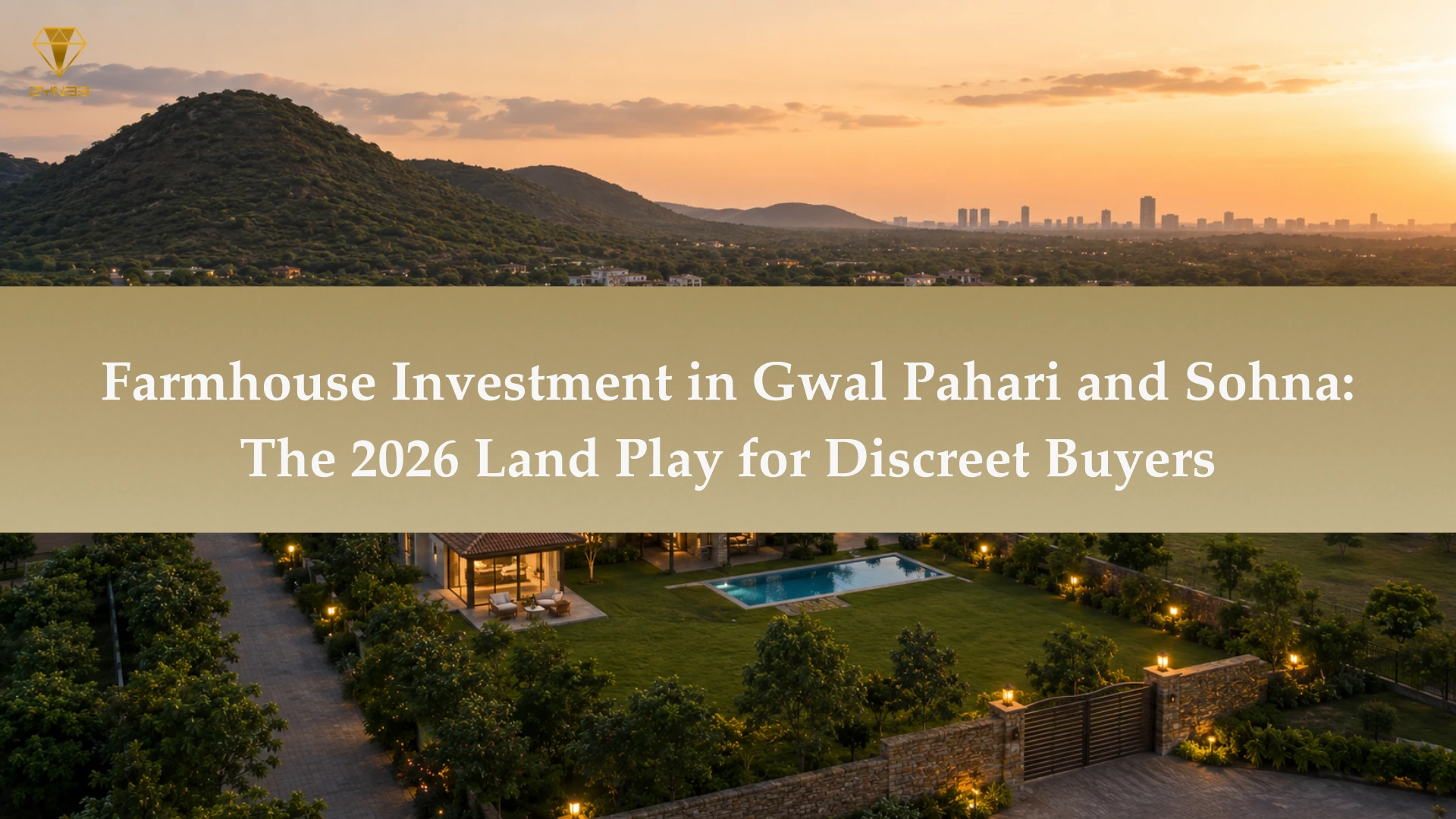
The Gurgaon farmhouse market splits sharply between two belts. Gwal Pahari, on the Gurgaon-Faridabad road in the Aravalli foothills, is the established ultra-premium enclave, where large farmhouses run to Rs 25 crore and beyond and land parcels are held by old wealth for privacy and prestige. Sohna, to the south, is far more accessible, with developed farmhouses from around Rs 4 crore per acre in gated projects and farm land ranging roughly Rs 1.5 crore to 9.75 crore per acre depending on location and development.
Sohna is where most 2026 activity sits. Gated farm communities near the Westin resort and along the Sohna-Palwal road offer CLU-approved plots from about Rs 3,100 to 6,500 per square yard, with 24-hour security, sweet groundwater, and Aravalli views. The market for farm land near gurgaon here is deepening precisely because the Delhi-Mumbai Expressway and Sohna Elevated Road have transformed its connectivity.
That connectivity is the value driver. A Sohna farmhouse now sits roughly 20 to 25 minutes from Rajiv Chowk, close to the KMP and Delhi-Mumbai expressways, with pollution levels a fraction of the city's.
The two belts sit at different cycle stages. Gwal Pahari is mature and scarcity-driven, where value comes from a fixed supply of Aravalli-adjacent land held tightly by long-term owners, so appreciation is steady and entry is expensive. Sohna is in a growth phase, where expressway connectivity and new gated developments are lifting a lower base, giving it the stronger appreciation runway. For pure land-play upside, Sohna is earlier in its cycle; for prestige and proximity to South Delhi, Gwal Pahari is the established choice.
Gwal Pahari. Price: ultra-premium, farmhouses to Rs 25 crore and up, large parcels held privately. Why it appeals: Aravalli setting, proximity to South Delhi, Golf Course Extension, and Faridabad, and a discreet, established address. The catch: much of this belt sits in the Aravalli zone, so land-use and forest-notification checks are critical. A farmhouse in gwal pahari is a prestige and preservation asset, not a value play.
Sohna and Sohna-Palwal. Price: from roughly Rs 4 crore per acre developed, plots from Rs 3,100 to 6,500 per square yard. Why it appeals: gated communities, strong connectivity, sweet water, and a genuine appreciation runway. The catch: quality and legal status vary widely between projects, so verification is everything. This is where the affordable, growth-oriented buyer looks.
Gated farm communities. Price: a premium over raw land for the infrastructure. Why they appeal: security, power backup, landscaping, black-top roads, and clear registered plots reduce the risk of buying raw agricultural land. The catch: confirm the developer's approvals and title chain. These suit buyers who want land ownership without the raw-land headaches.
Scenario A, the Sohna land play. A CLU-approved one-acre plot at around Rs 4 crore in a gated community offers land-backed appreciation as the expressway corridor matures, plus the option to build a retreat. The strongest combination of upside and usability.
Scenario B, the Gwal Pahari prestige hold. A large Aravalli-adjacent farmhouse is a preservation and lifestyle asset. Appreciation is steady rather than explosive, but the scarcity of the belt and its proximity to South Delhi protect long-term value. Best for buyers prioritising privacy and prestige over yield.
Scenario C, the income-generating retreat. A well-appointed Sohna farmhouse can earn experiential rental income, with well-located properties reportedly generating meaningful monthly returns through short-stay platforms, on top of appreciation. This suits buyers who want the asset to work between personal visits.
|
Profile |
Budget |
Belt |
Primary Driver |
|
Prestige and privacy |
Rs 15 Cr+ |
Gwal Pahari |
Scarcity, South Delhi proximity |
|
Value plus appreciation |
Rs 3-8 Cr |
Sohna, Sohna-Palwal |
Expressway-driven growth |
|
Security-first buyer |
Rs 4 Cr+ |
Gated farm communities |
Amenities plus clear title |
|
Income plus retreat |
Rs 3-6 Cr |
Developed Sohna farmhouse |
Short-stay income and use |
If you need liquidity within two years, farm land is among the least liquid assets, so exits can take time and depend on finding the right buyer. If you cannot fund thorough legal due diligence, raw agricultural land carries title and land-use risks that can erase your capital, so this is not a market to enter casually. And if you expect an apartment-style rental yield, a farmhouse is an appreciation and lifestyle asset, not a cash-flow one. In these cases, a different asset class serves you better.
|
What Matters |
What Is Noise |
|
Clear title, kila number, jamabandi, mutation |
An attractive brochure and site visit alone |
|
CLU or valid farmhouse land-use approval |
A verbal assurance that building is allowed |
|
Aravalli and forest-notification status |
The "green and peaceful" marketing pitch |
|
A registered sale deed, never a GPA sale |
A cheap price on a general power of attorney |
|
Developer approvals in gated projects |
Amenity lists and landscaping renders |
The single most important discipline in this market is legal verification. Much of the Aravalli belt, including parts near Gwal Pahari, is subject to land preservation and forest rules that can restrict or prohibit construction, so verify the exact status before buying. Insist on a registered sale deed with a clear title chain, a specific kila number, and jamabandi, and never accept a general power of attorney sale. A cheap farmhouse with a clouded title is the most expensive thing you can buy.
Several Timing Triggers are shaping this market. First, the Delhi-Mumbai Expressway and Sohna Elevated Road, which have permanently improved Sohna's connectivity and continue to lift land value. Second, the KMP Expressway and DND corridor, which widen the catchment for weekend retreats. Third, the scarcity of Aravalli-adjacent land near Gwal Pahari, which supports prices structurally. Fourth, rising demand for low-density, private assets, which keeps the segment liquid at the top end. Each trigger favours buyers who enter before the next leg of connectivity-driven appreciation.
The Entry Strategy is legal-first, then location. Engage a property lawyer to verify the title chain, land-use status, and any Aravalli or forest notification before committing. For value and growth, target CLU-approved farmhouse plots sohna in gated communities with registered plots and confirmed developer approvals. For prestige, buy in Gwal Pahari only with impeccable title and land-use clearance, given the Aravalli overlay. Prefer freehold with immediate registry and mutation, confirm sweet groundwater and power connectivity, and insist on a registered sale deed in every case.
The specific and most serious risk is legal: agricultural and Aravalli land can carry land-use restrictions, forest notifications, or title disputes that make construction impossible or ownership contestable, so verification is non-negotiable. The specific risk in raw land is illiquidity and the cost of developing basic infrastructure. The specific risk in gated projects is a developer whose approvals or title chain are incomplete. Each is manageable only with rigorous, lawyer-led due diligence before purchase, not after.
Price-based exit: Sohna land bought before major connectivity milestones can appreciate strongly as the corridor matures, so an exit after the expressway ecosystem fills in can realise solid gains. Event-based exit: infrastructure completions and new institutional or resort development nearby reprice adjacent land, offering natural sale windows. Time-based exit: for many buyers, especially in Gwal Pahari, the best strategy is a long hold or no exit at all, treating clean-title land as a generational, privacy-preserving store of value.
The Gurgaon farmhouse belt offers two clear paths in 2026. Gwal Pahari is the ultra-premium, scarcity-driven choice for buyers who prize privacy, prestige, and proximity to South Delhi, and who can navigate the Aravalli legal overlay. Sohna is the value and growth choice, with gated communities, expressway-driven appreciation, and a genuine runway. In both, the decision that matters most is not price or view, it is legal verification: clear title, valid land use, and a registered sale deed. Get the law right, and a farmhouse becomes one of the most durable, private, land-backed assets you can own.
If you are considering a farmhouse or farm-land purchase in Gwal Pahari or Sohna, the difference between a clean-title, CLU-approved asset and a legally clouded one is your entire capital. ZYN33, working with Strata Capital Holdings, verifies title chains, land-use status, Aravalli notifications, and developer approvals before you commit, and maps the right belt to your budget and objective. We do not sell projects. We convert informed intent into transactions. Share your goal and we will pressure-test any farmhouse against the checks that matter.
Strata Capital Holdings tracks land pricing, connectivity, and legal status across Gurgaon's farmhouse and plotted belts in real time. ZYN33 brings that intelligence to buyers evaluating a farmhouse for sale in gurgaon, so decisions rest on verified title and land-use facts rather than a scenic site visit. We work with buyers who are ready to decide.
Disclaimer
This article is general information about tax and property mechanics in India. It is not tax advice, investment advice or a recommendation to buy a specific property, and it does not account for your personal circumstances. Rates, thresholds and deadlines change. Verify every figure against the source listed above and take your liquidation plan to a qualified chartered accountant before you sell anything. ZYN33 distributes residential projects in Gurugram and is paid a transaction fee when a purchase completes. We do not act as your tax adviser or your adviser on the equity side.
Tell us your budget and timeline.
Tell us your budget and timeline.