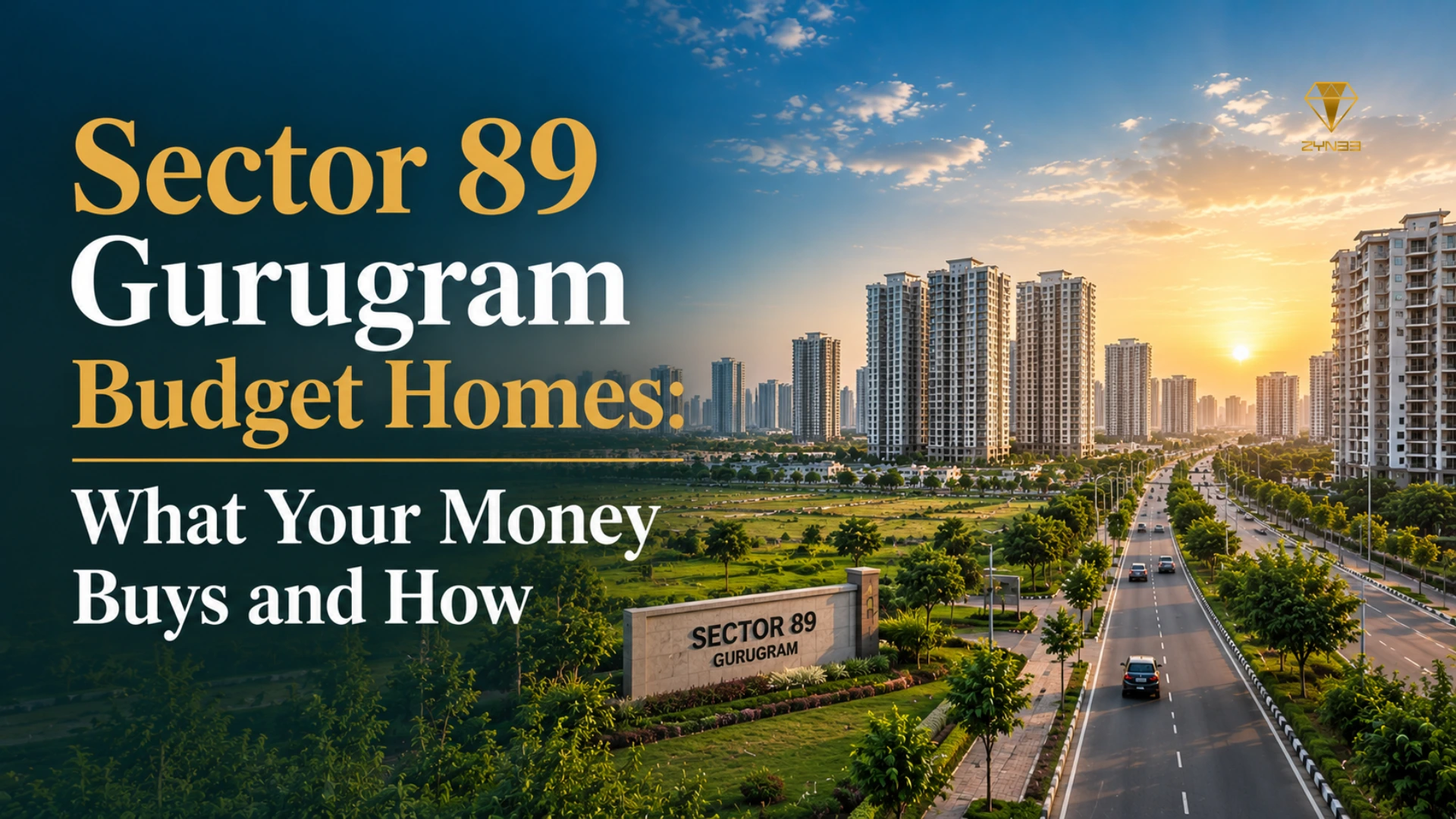
A budget home in Sector 89 means one of two different things. Policy housing under the Haryana Affordable Housing Policy sells at Rs 5,575 per sq ft of carpet area, fixed by the state and allotted by draw of lots rather than booking. Open market stock in the corridor asks about Rs 10,950 per sq ft of super area, which is roughly three times as much on a common basis. This covers which one you are being shown, how each is acquired, and what the sector actually printed last year.
Written by Mansi Joshi, Marketing Intelligence Lead, ZYN33 Investment Desk. Reviewed by Ritesh Arora, Founder, ZYN33 and Strata Capital Holdings, Gurugram. Advising on Gurugram residential capital allocation since 2023, with mandates ranging from Rs 3 Cr to Rs 50 Cr. Published 2 February 2026. Last reviewed 9 September 2026.
Disclosure: ZYN33 distributes residential projects in Gurugram and is paid a transaction fee when a purchase completes, including on projects we discuss with you. We do not give tax advice. This post is general information. Take it to your chartered accountant.
A budget home here means one of two different things. Policy housing sells at Rs 5,575 per sq ft of carpet area, fixed by the state. Open market stock in the corridor asks about Rs 10,950 per sq ft of super area.
Convert both to a common basis and the open market is roughly three times the policy price. They are different products acquired by different methods, and one of them you cannot simply book. Anyone comparing Sector 89 Gurugram budget homes needs to establish which of the two they are being shown before any price comparison means anything.
Rs 5,575 per sq ft of carpet area in Gurugram, set by notification rather than by the developer. The Haryana Cabinet revised the rates in March 2026 under the Affordable Housing Policy, 2013.
|
Zone |
Maximum allotment rate, per sq ft carpet |
|
Gurugram |
Rs 5,575 |
|
Sohna and Faridabad |
Rs 5,450 |
|
Other high and medium potential towns |
Rs 5,050 |
|
Low potential towns |
Rs 4,250 |
Balcony area is charged separately at Rs 1,300 per sq ft, capped at Rs 1.30 lakh. So a 645 sq ft carpet unit works out at about Rs 37.26 lakh all in. The affordable housing allotment rate is inclusive of external development charges, so a developer cannot add EDC on top.
Two more features matter. The revised rates apply where allotment has not yet taken place, so a project already allotted continues at its earlier price. And where a draw has happened and rates were revised afterwards, selected applicants pay the revised price. They may withdraw instead and take a full refund without deduction.
By draw of lots against eligibility criteria, not by booking. This is the single most important practical difference and most coverage of the segment omits it.
The developer invites applications, applicants must meet the policy's eligibility conditions, and allotment runs by draw. If applications fall short of the sanctioned flats, allotment can proceed in phases. You cannot reserve a unit, choose a floor, or negotiate the price.
The policy also restricts transfer for a defined period after allotment, which is the point that makes a resale-led investment case in this segment unworkable. Read the policy conditions and the allotment letter for the specific project rather than assuming the terms. Take them to a lawyer if the plan involves an early exit.
One protection worth knowing. If the licensee fails to obtain environmental clearance within a year of the draw, the allottee can demand a refund with interest. Construction cannot begin before that clearance.
Sector 89 flats printed about plus 5.2 percent over twelve months, against New Gurgaon flats at plus 4.8. Modest, positive and in line with the corridor.
Any Sector 89 price trend presented as a smooth multi year series should be treated carefully. A table rising by an identical percentage every single year is a compounding formula, not a market reading. Real sector data does not behave that way. Across Gurugram over the last twelve months, sectors printed anywhere from minus 8.6 percent to plus 20.3, which Gurgaon property price trends sets out in full.
We are not publishing a multi year price series for this sector. We do not hold registered transaction data for it, and portal series at single sector level are thin. What we can give you is the twelve month print above, the corridor context below, and the collector rate as a floor.
About Rs 10,950 per sq ft on flats, which is the cheapest genuine corridor entry in Gurugram outside Sohna town.
The New Gurgaon open market yields roughly 2 percent gross on portal data, before maintenance, vacancy and slab tax. Sector level prints within the corridor vary widely. Sector 88A moved plus 14.4 percent, Sector 95 plus 9 and Sector 89 plus 5.2. Sector 91 managed plus 1.9 and Sector 76 minus 1.8 on flats.
Set that against the policy rate and the comparison becomes clear. At 60 percent carpet efficiency, Rs 5,575 carpet is about Rs 3,345 per sq ft super equivalent. The open market therefore asks roughly 3.3 times as much. That gap is the price of a freely transferable, freely chosen, negotiable asset rather than a discount you are missing out on.
Policy housing if you qualify and can wait for a draw, open market if you need flexibility, and neither for rental income. Four situations sort it.
Eligible for affordable group housing and able to hold past the transfer restriction? Apply, since the entry is roughly a third of open market equivalent on a common basis. Wanting a home you can choose, negotiate and sell freely? Open market at about Rs 10,950, where Rs 1 crore buys around 913 sq ft of super area. The New Gurgaon property market read covers the format choice.
Planning to flip a policy allotment? The transfer restriction blocks that, and the plan fails on the policy conditions rather than on the market. Buying for income? Corridor yields sit near 2 percent. If this is not you, stop here.
No. Nothing sanctioned reaches this sector, and the nearest approved station on the corridor is several sectors away.
The Union Cabinet approved the Millennium City Centre to Cyber City corridor in June 2023 at 28.5 km across 27 stations. Its Dwarka Expressway station sits at Sector 101, on a 1.85 km spur to the Basai depot. The Haryana Cabinet revised the project cost to Rs 10,266.54 crore on 18 May 2026, and coverage of that decision publishes no replacement completion date.
A separate alignment from Sector 56 towards Panchgaon has had its detailed project report cleared at board level. It awaits sanction, which is not the same as being under construction. So price the station you can name, at the distance it actually sits.
Six things, and the first establishes which product you are dealing with.
Confirm whether the project is affordable group housing under the 2013 policy or open market stock. The price basis, acquisition method and your transfer rights all differ. Then pull the HARERA registration number for the specific phase and verify it at haryanarera.gov.in. Gurugram and Panchkula are separate benches, and sites such as hrera.in and hrera.org.in are not the authority.
Third, read the filed completion date rather than the marketed one. Fourth, on policy projects confirm no external development charge is being added, since the notified rate is inclusive. Fifth, on open market stock ask for the carpet area and recompute the rate on it. Sixth, check the promoter entity for insolvency proceedings on the public records, which is a check almost nobody runs in this segment.
What does not decide it: a developer's brand, an amenity list, or a smooth-looking price chart.
Anyone planning to resell a policy allotment inside the restriction period. The policy blocks it, and no market condition changes that.
Anyone buying for rental income at corridor yields near 2 percent gross. Anyone pricing in a metro station that is not sanctioned for this sector. Anyone relying on a compounding price table as evidence of past performance. And anyone with an exit horizon under five years, given roughly 8 percent in entry costs against a sector printing plus 5.2 percent.
Early to mid, in the cheapest corridor in Gurugram, with the deepest standing inventory in the city. That combination caps how fast it can move.
New Gurgaon carries over 3,000 listed apartments plus builder floors and plots, which is more standing supply than any other Gurugram corridor. Deep inventory supports affordability and suppresses price movement. That is why the corridor printed plus 4.8 percent while Golf Course Extension sectors printed up to plus 20.3.
What is ahead is Global City. Phase 1 covers roughly 587 acres under a Rs 940 crore contract awarded in 2023, targeted for completion by end 2026. Targeted is not confirmed, and Haryana infrastructure routinely runs 12 to 24 months late. Our Global City progress across Sectors 84, 88 and 37D read covers the status.
With a carpet rate ceiling written down and the corridor average as your floor, which is about Rs 10,950 per sq ft on super area.
Add only the premium you can defend for the specific project, and set a walk away number. Deep inventory works in your favour here. With more than three thousand listed apartments across the corridor, a seller holding out has competition you do not.
Ask for the last three registered transactions in the same project. Then check the collector rate for the sector, since duty applies to the higher of your price or that rate. The April 2026 revision changed the floor in about half the district. Our Gurugram circle rate revision read explains how to find your entry.
Product confusion is the first Risk, and it is the reason for this post. Comparing a Rs 5,575 carpet rate with a Rs 10,950 super rate produces a conclusion wrong by about three times.
Transfer restriction is second, and specific to policy stock. An allotment you cannot sell for a defined period is not an investment instrument, whatever the entry price looks like.
Third, supply depth. Over 3,000 listed apartments in the corridor means your resale competes with new launches as well as other resales. Fourth, delivery, since policy projects have historically carried longer timelines and the environmental clearance condition exists because that has been a real failure point.
Price based: measure against registered comparables in your own project rather than the corridor average. Then net out duty already paid, exit costs and capital gains before calling anything a return.
Event based: the trigger is Global City reaching visible completion rather than being announced. Take it twelve to eighteen months after delivery, not after a press release.
Time based: five to seven years on open market stock, and longer on a policy unit where the transfer restriction runs first. Hold beyond 24 months at minimum so gains are long term rather than taxed at slab.
Policy housing if you qualify, open market if you need flexibility, and neither if you want income or a quick exit.
The honest read on Sector 89 Gurugram budget homes is that the label covers two products. They sit roughly three times apart on price and differ completely in how you acquire them. The sector itself printed a modest plus 5.2 percent last year in the cheapest and deepest corridor in Gurugram. Establish which product you are being shown and verify the registration. Treat any smooth multi year price chart as a formula until someone shows you the source.
Considering Rs 35 lakh to Rs 1.5 Cr in Sector 89 with a decision due in 60 to 90 days? Tell us whether you are looking at policy housing or open market stock. We return the HARERA registration and filed possession date for each project, plus the applicable rate with its area basis. The twelve month sector print comes with it.
Strata Capital Holdings tracks price band shifts, infrastructure timelines and inventory movement across Gurugram's corridors. ZYN33 brings that into every allocation conversation.
Haryana Cabinet decision, March 2026: allotment rates raised to Rs 5,575 per sq ft carpet for Gurugram, Rs 5,450 for Faridabad and Sohna, Rs 5,050 for other high and medium potential towns and Rs 4,250 for low potential towns, with balcony charges at Rs 1,300 per sq ft capped at Rs 1.30 lakh. Rates apply where allotment has not yet taken place
Press Information Bureau, Gurugram Metro sanction June 2023 at 28.5 km and 27 stations
Deputy Commissioner Gurugram, public statement on the 2026-27 collector rates: effective 1 April 2026, average increase 15 to 30 percent, about 51 percent of the district unchanged, around 11 percent rising up to 75 percent
Insolvency and Bankruptcy Board of India, public records for checking promoter solvency
Disclaimer
This article is general information about tax and property mechanics in India. It is not tax advice, investment advice or a recommendation to buy a specific property, and it does not account for your personal circumstances. Rates, thresholds and deadlines change. Verify every figure against the source listed above and take your liquidation plan to a qualified chartered accountant before you sell anything. ZYN33 distributes residential projects in Gurugram and is paid a transaction fee when a purchase completes. We do not act as your tax adviser or your adviser on the equity side.
Tell us your budget and timeline.
Tell us your budget and timeline.