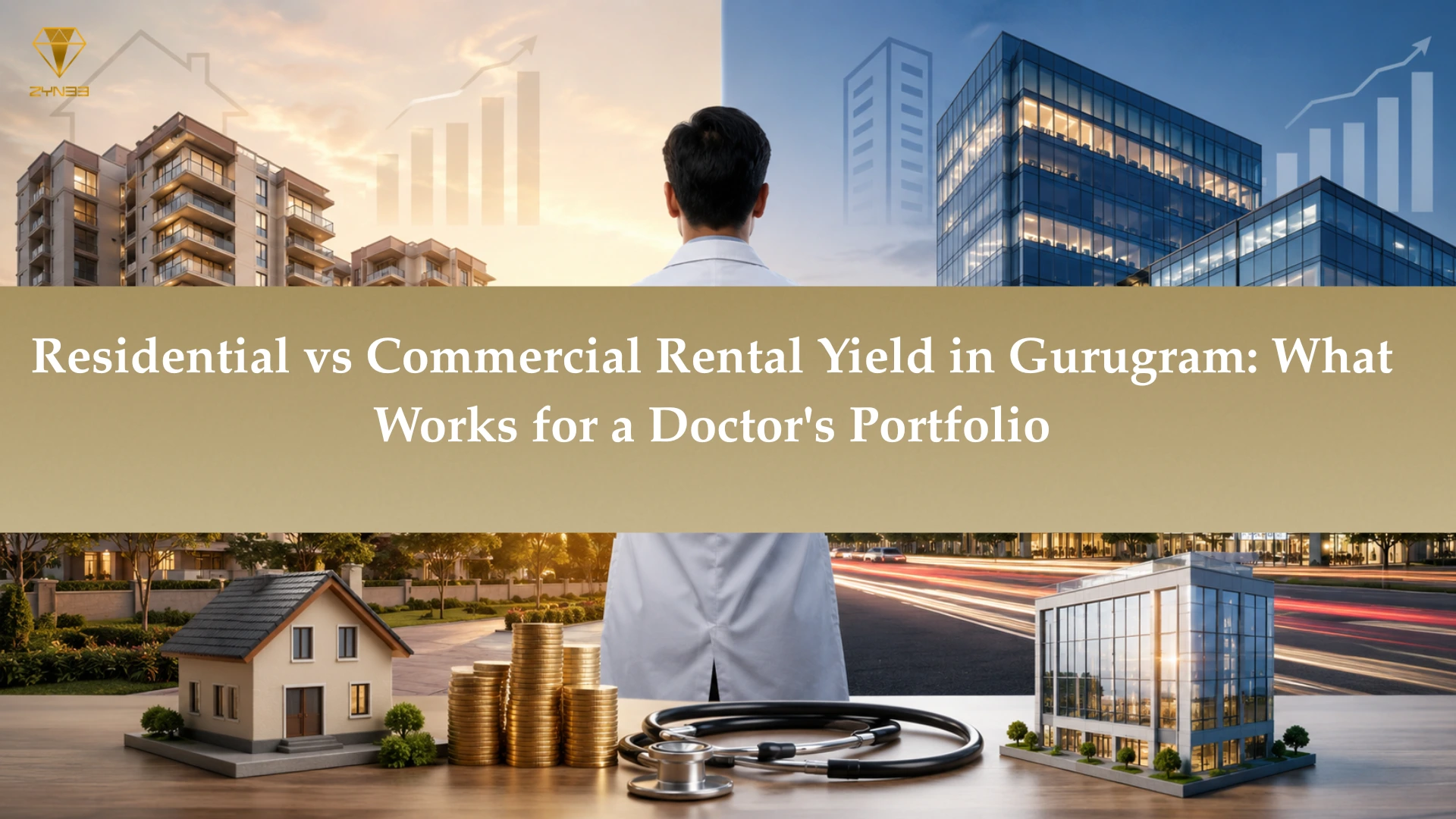
Gurugram residential yields verify at 2 to 3 percent, not the 3.5 to 4.5 usually printed, and Golf Course Road is the joint highest in the city rather than the weakest. Commercial does pay more, but 18 percent GST on rent is a dead cost to a clinic tenant who cannot reclaim it, and rent above Rs 6 lakh is taxed at source. This works the net arithmetic and says which asset a doctor should own first.
Written by Mansi Joshi, Marketing Intelligence Lead, ZYN33 Investment Desk. Reviewed by Ritesh Arora, Founder, ZYN33 and Strata Capital Holdings, Gurugram. Advising on Gurugram residential capital allocation since 2023, with mandates ranging from Rs 3 Cr to Rs 50 Cr. Published 28 July 2026. Last reviewed 26 September 2026.
Disclosure: ZYN33 distributes residential projects in Gurugram and is paid a transaction fee when a purchase completes, including on projects we discuss with you. We do not give tax advice. This post is general information. Take it to your chartered accountant.
Two to three percent gross. Not three and a half to four and a half.
|
Corridor |
Gross yield |
What that means |
|
Golf Course Road |
3 percent |
Joint highest in Gurugram, at Rs 27,800 per sq ft |
|
Sector 43 |
3 percent |
Joint highest, on older and cheaper stock |
|
New Gurugram, Sectors 82 to 95 |
2.6 percent |
Good, but below the two above |
|
Dwarka Expressway, Sohna Road |
about 2 percent |
Appreciation corridors, not income ones |
Notice what that does to the usual advice. Sectors 82 and 89 get named as the city's strongest yield pockets. They are not. Golf Course Road gets written off for high capital values, but rents there kept pace.
So residential rental income gurgaon runs about a third below the figure in circulation. On a Rs 1.2 crore flat in Sector 89 that is Rs 3.1 lakh a year, not Rs 4.8 lakh. Our project level read shows the spread.
Less than eleven percent, and nobody publishes the number you need to check it.
Office rents are public. Cyber City and the Golf Course spine quote Rs 110 to Rs 200 per sq ft a month. Golf Course Extension runs Rs 70 to Rs 120, Sohna Road Rs 50 to Rs 85.
Where a listing prints both rent and price, commercial rental yield gurgaon computes to 3.2 to 7.0 percent. Those are secondary units, not the prime towers above, whose sale rates are not published. An 8 to 11 percent figure quoted without the price behind it is not a yield.
This matters most to a doctor and appears in no comparison of the two asset classes.
Commercial rent carries 18 percent GST. Residential rent to someone for their own home carries none. That is not a cost to you, since you collect it and remit it. It is a cost to your tenant.
For most tenants it washes out, because a registered business reclaims it as input tax credit. A clinic cannot. Healthcare by a clinical establishment is GST exempt, so there is no output tax to set the credit against. The 18 percent is a real addition to occupancy cost.
Read that back against the plan. A doctor buying a commercial floor usually means to let it to diagnostics or another practice. Those tenants cannot reclaim the tax, so they negotiate the base rent down. Your achievable rent sits below the corridor office rate.
Cross either one and the asset stops being passive.
|
Threshold |
Trigger |
Rent of Rs 3.1 L |
Rent of Rs 21 L |
|
Tax deducted at source |
Above Rs 6 lakh a year |
Below. None |
Above. 10 percent withheld |
|
GST registration |
Turnover above Rs 20 lakh |
Exempt supply |
Above. Register and file |
Rent on land and buildings is withheld at 10 percent under Section 393(1) of the Income-tax Act 2025. That provision replaced Section 194-I on 1 April 2026. The threshold is Rs 50,000 a month.
Withholding is not an extra tax, since you claim it back. But a consultant paying advance tax now has rent arriving net and a credit to reconcile. Our tax read covers the rest.
The GST line is heavier. Rental income counts toward aggregate turnover, so passing Rs 20 lakh makes you a registered person filing returns. Skip it and your registered tenant pays under reverse charge, which has applied since 10 October 2024. They will price that into what they offer you.
The usual version contains an arithmetic slip worth correcting, because it is the sentence people remember.
|
Residential, Sector 89 |
Commercial, low band |
Commercial, top band |
|
|
Ticket |
Rs 1.2 Cr |
Rs 3 Cr |
Rs 3 Cr |
|
Verified gross yield |
2.6 percent |
3.2 percent |
7.0 percent |
|
Rent a year |
Rs 3.1 L |
Rs 9.6 L |
Rs 21.0 L |
|
Advantage per rupee |
base |
1.2 times |
2.7 times |
Commercial at Rs 21 lakh against residential Rs 3.1 lakh is 6.7 times the income. It is not 6.7 times the return. It took 2.5 times the capital to buy.
Per rupee the advantage is 1.2 to 2.7 times, depending where in the band you land. Both yields are gross. Deduct maintenance, vacancy and brokerage and each falls by a fifth.
Three profiles, and none of them is a compromise.
If this is your first let asset, start residential. The ticket is smaller and the buyer pool at exit is deep. A vacancy costs weeks rather than quarters. Our hospital cluster read maps where to buy it.
Cannot spare time? Avoid raw SCO plots entirely. Land plus construction plus several floors and several tenants is a development project, not passive income for doctors. Our SCO read sets out that workload.
If the capital may be needed back inside two years, buy neither. Commercial resale is thin and slow. Even residential takes months at a price you would accept.
|
What matters |
What is noise |
|
The price the yield was divided into |
A percentage quoted on its own |
|
Whether your tenant can reclaim GST |
The corridor's headline office rent |
|
Who the tenant is and the lease term left |
An assured return promised by a developer |
|
Months to sell at a price you accept |
The valuation quoted to you at purchase |
Three things, and only one is about price. Office absorption in your micro-market, because a commercial yield is only as good as the tenant behind it. Internal roads and social infrastructure in New Gurugram, which lifts 2.6 percent toward 3. And any change to GST on rent.
Buy in sequence, and price off net rather than gross.
Ask the seller for the rent roll and the price it was divided into. A yield missing either half cannot be checked. Then take the gross down by a fifth for costs.
On commercial, read the lease before the brochure. Who the tenant is, how long is left, what the escalation clause says. Then ask whether they can reclaim the GST you will charge. On anything unfinished, verify the HARERA registration and the filed completion date.
Residential risk is that the yield is simply low. At 2 to 3 percent it earns less than a fixed deposit, so the case rests on capital growth. If appreciation stalls, the reason for holding has gone.
Commercial risk is concentration. One tenant leaves and the yield goes to zero until another arrives. In a soft market that is quarters, and an EMI funded from uncontracted rent is exposed twice.
A plot you build out carries both, plus construction. You become developer, landlord and leasing agent on top of a clinical week.
Liquidity based: hold the flat as the asset you can convert, and sell it first if capital is needed quickly.
Lease based: sell commercial with term remaining, never after a tenant has gone. A vacant unit is valued on hope and a let one on income.
Time based: if the income case has not worked in seven years, the thesis is wrong.
Buy residential first. Add commercial only when you can absorb a vacant quarter without it reaching your practice.
The commercial advantage is real. Corrected, it is 1.2 to 2.7 times per rupee rather than four. It also brings a tax registration, a withholding credit and a tenant who may not reclaim what you charge. That work is the honest price of the higher number.
Holding Rs 1 Cr to Rs 5 Cr and deciding which income asset to buy? Send the shortlist. We divide the rent by the price on each and tell you what it yields.
Strata Capital Holdings tracks price bands, rents and inventory across Gurugram's corridors. ZYN33 brings that into the room when capital is placed. We distribute residential projects and are paid a transaction fee when a purchase completes, including on anything we discuss with you.
99acres, retrieved 16 September 2026: Golf Course Road flats at Rs 27,800 per sq ft, yield 3 percent, joint highest with Sector 43. New Gurugram Sectors 82 to 95 compute to 2.6 percent. Dwarka Expressway and Sohna Road near 2. Asking prices on super built up area
Gurgaon office rent per sq ft per month, 2026 sector guide: Cyber City and Golf Course Road Rs 110 to Rs 200, Golf Course Extension Rs 70 to Rs 120, Sohna Road Rs 50 to Rs 85, New Gurgaon Rs 45 to Rs 75. Sale rates are not published at sector level, so the 3.2 to 7.0 percent band comes only from listings printing both
GST on renting immovable property: 18 percent on commercial letting, nil on residential letting to an individual for personal use. Registration required once aggregate turnover exceeds Rs 20 lakh. Reverse charge applies where a registered tenant leases from an unregistered landlord, per Notification 09/2024-Central Tax (Rate), effective 10 October 2024
Healthcare by a clinical establishment or authorised medical practitioner is exempt under Entry 74 of Notification 12/2017-Central Tax (Rate). A supplier making only exempt supplies cannot claim input tax credit, so GST on its rent is an absorbed cost
TDS on rent: Section 393(1) of the Income-tax Act 2025, in force 1 April 2026, replacing Section 194-I. Rate on land and buildings is 10 percent. Threshold Rs 50,000 a month, or Rs 6 lakh a year. Take your own position to a chartered accountant
Yield and per rupee comparisons are ZYN33 calculation on a Rs 1.2 crore residential ticket at 2.6 percent and a Rs 3 crore commercial ticket at both ends of the computed band, gross of costs. Current figures, not forecasts
Disclaimer
This article is general information about tax and property mechanics in India. It is not tax advice, investment advice or a recommendation to buy a specific property, and it does not account for your personal circumstances. Rates, thresholds and deadlines change. Verify every figure against the source listed above and take your liquidation plan to a qualified chartered accountant before you sell anything. ZYN33 distributes residential projects in Gurugram and is paid a transaction fee when a purchase completes. We do not act as your tax adviser or your adviser on the equity side.
Tell us your budget and timeline.
Tell us your budget and timeline.