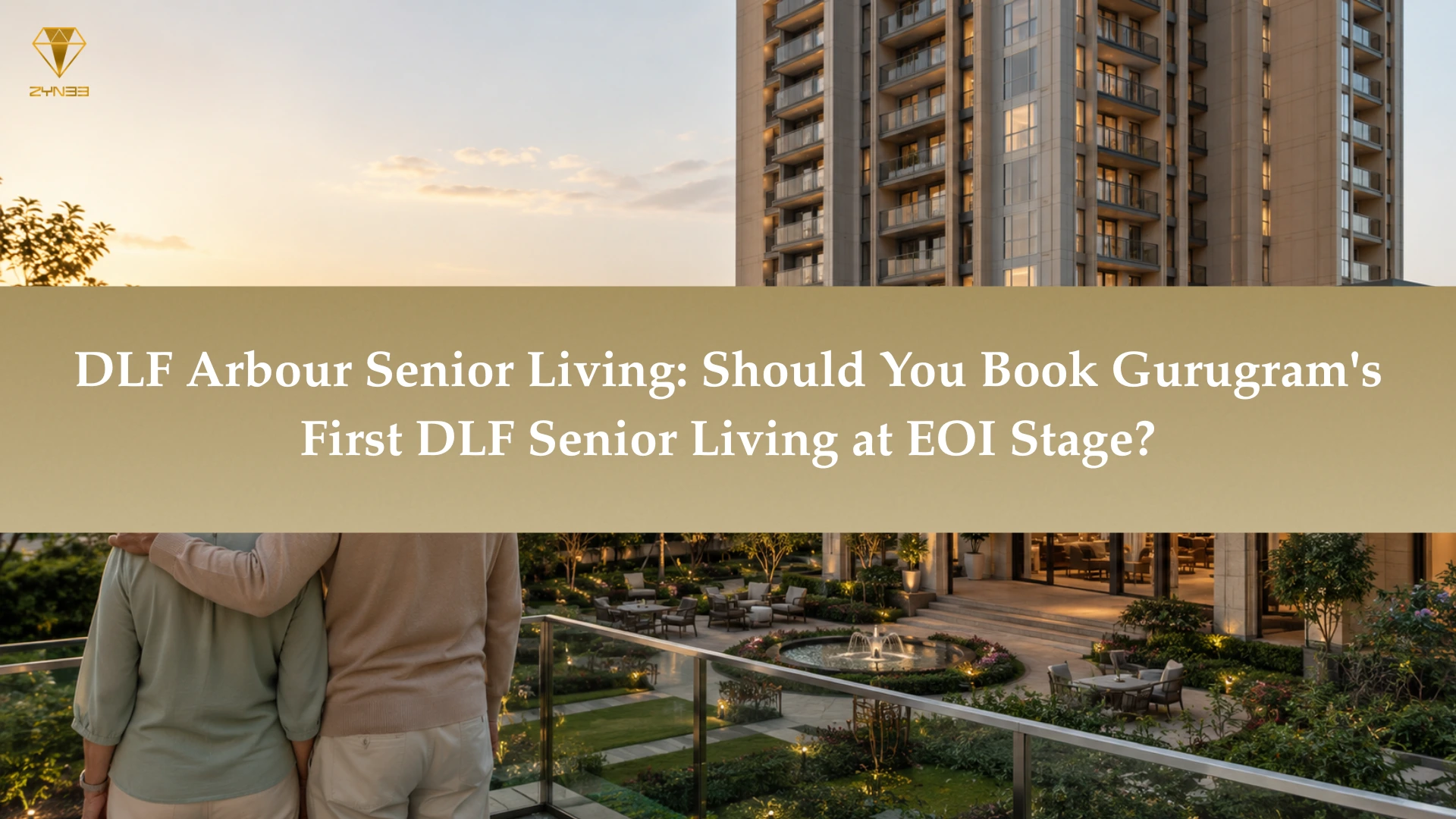
Section 3(1) of the Real Estate (Regulation and Development) Act bars booking, selling or offering for sale any apartment in an unregistered project, and an undated cheque is a payment instrument rather than a reservation. So the answer on EOI stage is wait. This covers what a registration actually gives you, what the corridor is really doing at minus 0.8 percent, and what to verify the day the number appears.
Written by Mansi Joshi, Marketing Intelligence Lead, ZYN33 Investment Desk. Reviewed by Ritesh Arora, Founder, ZYN33 and Strata Capital Holdings, Gurugram. Advising on Gurugram residential capital allocation since 2023, with mandates ranging from Rs 3 Cr to Rs 50 Cr. Published 7 August 2026. Last reviewed 6 September 2026.
Disclosure: ZYN33 distributes residential projects in Gurugram and is paid a transaction fee when a purchase completes, including on projects we discuss with you. We do not give tax advice. This post is general information. Take it to your chartered accountant.
Wait. Section 3(1) of the Real Estate (Regulation and Development) Act, 2016 bars booking or selling any apartment in an unregistered project.
That is the answer, and it holds regardless of the developer's name. DLF The Aureva may well be a strong asset once it is registered. Until then, the question is not whether to capture a launch price but whether to hand over money with no statutory protection attached to it.
More than the name suggests, if a cheque changes hands.
An undated cheque is a payment instrument, not a placeholder. Once it is in someone else's possession, they can insert a date and present it. A written assurance that it is refundable governs what should happen afterwards. It does not prevent presentation.
The protection you are giving up is specific. Before registration there is no filed completion date and no ringfenced project account. There is no quarterly progress reporting, and no Section 18 remedy if the project is delayed. Those four things are what registration buys you, and none exist at expression of interest stage. RERA Haryana benefits sets out each in full.
Four protections, and they only attach once the number is live on the authority portal.
|
Protection |
Before registration |
After |
|
Filed completion date |
None |
Binding, with a remedy |
|
Project account |
None |
Funds ringfenced |
|
Progress reporting |
None |
Quarterly, public |
|
Delay remedy |
None |
Section 18 interest or refund |
|
Cap on advance |
None |
10 percent before a written agreement |
That last line matters most at launch. A promoter cannot take more than 10 percent of the cost before executing a written agreement for sale. It is a statutory limit and your answer to any request for more. Possession delays covers what happens when a filed date slips.
Verify the HARERA registration yourself at haryanarera.gov.in when it appears. Gurugram and Panchkula are separate benches of one authority, and hrera.in and hrera.org.in are not government domains.
Falling. Golf Course Extension Road is the only Gurugram corridor currently in decline.
|
Corridor |
Asking |
12 months |
Yield |
|
Dwarka Expressway |
Rs 14,000 |
plus 12.0 percent |
2 percent |
|
Golf Course Road |
Rs 27,800 |
plus 6.5 percent |
3 percent |
|
Golf Course Extension Road |
Rs 19,550 |
minus 0.8 percent |
2 percent |
This corridor is frequently described as the city's fastest appreciating luxury belt. Over twelve months it declined, while Golf Course Road rose 6.5 percent and Dwarka Expressway 12.0.
Over five years the picture is better: Golf Course Extension returned 113.7 percent against Golf Course Road's 96.5. So the corridor did deliver, and has now paused. With 7,895 listed properties it is also the deepest supply in the city, as our corridor read covers.
It may be sound. It is also unverifiable right now, and the published figures do not agree with each other.
A launch band of Rs 30,000 to Rs 35,000 per sq ft circulates. So does a ticket of about Rs 12 crore for 4,200 sq ft homes. That ticket works out to Rs 28,571 per sq ft, below the stated band. One of those two numbers is wrong, and neither can be checked until a filing exists.
The same applies to the comparisons used to support early entry. Figures for DLF Arbour, DLF Privana and Oberoi Three Sixty North circulate widely without a published source. Treat a launch price as an edge only once there is a registration number to price it against.
The demand argument is genuine. The asset behaviour is less well understood than the apartment market, and that cuts both ways.
Organised senior living in India is thin, and an ageing affluent population plus non-resident families seeking trusted care for parents is a durable driver. A branded developer entering the segment on an established corridor is a reasonable expression of that.
What is not established is resale. This is a niche buyer pool, and an exit depends on finding another household wanting that specific product at that specific price. Do not assume the liquidity of a standard luxury apartment, and do not model rental income. Delivered luxury stock is the comparison worth running.
A family buying a home for a parent, or for themselves, on a horizon past 2030. Four situations sort it.
Buying a residence you or a parent will occupy, with capital you will not need for the better part of a decade? That is what this product is for. Buying the developer's brand and an established address? Both are real, and both will still be there after registration.
Buying for rental income? This format does not produce it. Buying to resell before possession? There is no secondary market in an unregistered project, and a niche one afterwards. If this is not you, stop here.
Six things, in order, and the first is the only one that involves money.
Do not transfer funds or hand over a cheque, dated or undated, before a registration number is live on the authority portal. If you have already given one, ask for it back in writing and keep the correspondence.
Second, register your interest without a financial instrument, by email, so you have a dated record of your position. Third, ask the seller in writing when registration is expected and what the application status is.
Fourth, when the number appears, pull the filed completion date and the registered promoter entity yourself. Fifth, get the carpet area from the filing and recompute the quoted rate on it. Sixth, confirm nothing above 10 percent is sought before a written agreement for sale.
Anyone who cannot leave capital untouched until the 2030s. A senior living purchase at launch is among the longest lock-ups available in this market.
Anyone buying for yield, which this format does not deliver. Anyone expecting apartment-like resale depth in a niche segment. Anyone underwriting on a corridor that is rising, when this one printed minus 0.8 percent. And anyone who would feel pressure to convert an expression of interest into a booking before the registration appears.
Pre-registration commitment is the first Risk and it is the reason this post exists. Money placed before registration has none of the five protections in the table above.
Horizon is second. A launch completing in the 2030s means a decade of exposure to the developer, the segment and your own circumstances.
Third, resale depth in a niche category. Fourth, corridor direction, with Golf Course Extension Road declining and 7,895 competing listings. Fifth, unverifiable pricing, where the figures published for this launch contradict one another.
Price based: against registered comparables inside the project once they exist, restated on carpet. In a new segment those take years to form.
Event based: registration is the first milestone, completion the second. Neither is a selling trigger so much as a point to reassess.
Time based: possession plus three years at minimum, given how thin secondary demand is likely to be early on. Hold beyond 24 months so gains are long term rather than taxed at slab.
Do not. Wait for the registration number, then evaluate the project on the filing.
The case for DLF The Aureva may prove strong. A capable developer, an established address and an under-supplied segment are genuine. None of that is diminished by waiting. The cost of waiting is a price difference you cannot currently quantify, since the published figures contradict each other. The cost of not waiting is every protection the law provides. On a purchase of this size and duration, that is not a close call.
Considering this project or another senior living launch with Rs 8 Cr to Rs 15 Cr? Tell us which. We will tell you whether a registration number exists today. If it does, we return the filed completion date, the registered promoter entity, and the carpet area with the rate recomputed on it. If it does not exist, we will tell you that too, and we will not ask you for anything in the meantime.
Strata Capital Holdings tracks price band shifts, infrastructure timelines and inventory movement across Gurugram's corridors. ZYN33 brings that into every allocation conversation. We are paid a transaction fee when a purchase completes. That is why we would rather you check the filing than take our word for it.
Negotiable Instruments Act, 1881: a cheque handed over undated may have a date inserted by the holder and be presented for payment. A separate written assurance of refundability governs the obligation to repay but does not prevent presentation
Pricing circulated for this launch is internally inconsistent: a band of Rs 30,000 to 35,000 per sq ft is published alongside a ticket of about Rs 12 crore for 4,200 sq ft homes, which computes to Rs 28,571 per sq ft. Comparative figures circulated for DLF Arbour, DLF Privana and Oberoi Three Sixty North could not be traced to a published source. None is adopted here. No completion date is cited, because no registration exists to file one
Stamp duty in Haryana: inside municipal limits 7 percent for a male buyer, 5 percent for a female buyer and 6 percent for joint registration. Registration adds about 1 percent of assessable value capped at Rs 50,000
Disclaimer
This article is general information about tax and property mechanics in India. It is not tax advice, investment advice or a recommendation to buy a specific property, and it does not account for your personal circumstances. Rates, thresholds and deadlines change. Verify every figure against the source listed above and take your liquidation plan to a qualified chartered accountant before you sell anything. ZYN33 distributes residential projects in Gurugram and is paid a transaction fee when a purchase completes. We do not act as your tax adviser or your adviser on the equity side.
Tell us your budget and timeline.
Tell us your budget and timeline.